
Legal review: Written and reviewed by a specialised legal team.
Last updated:2026/08/18.
Category: UAE Criminal Law.
The rules governing diyya (blood money) in the UAE are rooted in Islamic law and national legislation concerning offences against life and bodily integrity. They are particularly important in cases involving death caused by negligence or error.
UAE law sets the diyya for a person who dies as a result of an unintentional act, whether male or female, at AED 200,000. Other criminal penalties or legal rights arising from the incident may still apply, depending on the circumstances of each case.
To learn more about the Diyya Law in the UAE, the amount payable, and the differences between diyya, arsh and compensation, read on.
Are you seeking to recover your financial rights or facing a diyya claim following an accident in the UAE? Do not let complicated procedures put your rights at risk.
Or continue reading to understand how diyya is calculated under UAE law.
جدول المحتوبات
What Is the Diyya Law in the UAE?
Diyya is an important legal subject in the UAE, particularly following accidents that cause a person’s death or result in bodily injury. Many people want to know what diyya means, how much it is, who is responsible for paying it, and whether additional compensation can be claimed alongside it.
The UAE legislature regulates diyya under the Crimes and Penalties Law as a financial right arising from certain offences against a person’s life or bodily integrity, particularly where qisas (retaliatory punishment) is not imposed or death results from an unintentional act.
Diyya is not awarded merely because a death has occurred. Legal liability for the incident must be established, along with a causal link between the wrongful act and its consequences. This is determined through official investigations, police and forensic reports, and evidence presented to the court.
When Is Diyya Payable in the UAE?
Under the Diyya Law in the UAE, diyya is payable in the circumstances specified by law, particularly when a person dies as a result of an error, negligence or failure to take necessary precautions.
Examples of incidents that may give rise to diyya include:
- Road traffic accidents resulting in a person’s death.
- Mistakes caused by negligence or a lack of attention.
- Certain incidents in which a breach of safety rules causes an unintended death.
Entitlement to diyya is determined after examining the circumstances of the incident and establishing the elements of liability. A death alone does not make someone liable to pay diyya; the wrongful act and its direct causal connection to the harm must be proven.
How Much Is Diyya in the UAE?
Under Article 30 of the UAE Crimes and Penalties Law, diyya for a person who dies as a result of an unintentional act, whether male or female, is set at AED 200,000.
The law also allows the amount of diyya to be amended by a decision of the Council of Ministers, based on a proposal from the Minister of Justice, so that the amount may be updated in line with legal requirements.
Accordingly, for anyone searching for the diyya amount in the UAE or asking, “How much is diyya in the UAE?”,
the amount prescribed by law for a death caused by an unintentional act is AED 200,000.
This amount applies in cases of accidental death once the responsible person’s legal liability has been established through the prescribed procedures.
Does the Amount of Diyya Depend on the Deceased’s Gender?
Under the statutory provision, diyya for an accidental death is AED 200,000, whether the deceased was male or female.
The amount therefore does not depend on the deceased person’s gender. Instead, entitlement depends on the nature of the incident and whether the relevant legal requirements are met.
Is Diyya Different for Intentional and Accidental Killing?
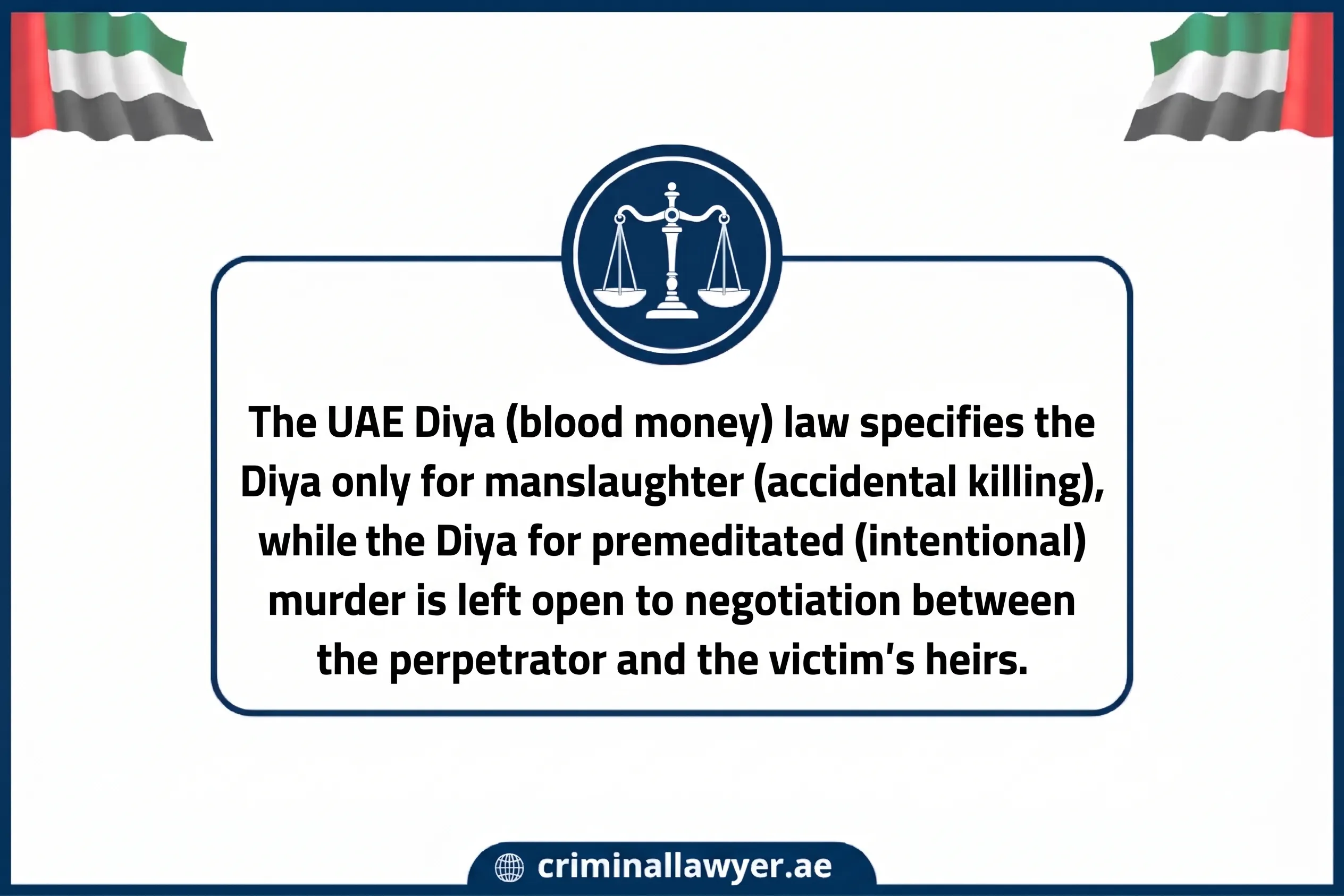
Yes. Intentional killing and accidental killing are governed by substantially different legal rules.
Accidental killing occurs when death is caused without a prior intention to take a person’s life, whereas intentional killing involves criminal intent.
Accidental Killing in the UAE
In cases of accidental killing, the following matters are considered:
- How the incident occurred.
- The degree of error or negligence.
- Whether there is a direct causal link between the wrongful act and the death.
- The evidence and official reports relating to the incident.
Accidental killing may result in criminal penalties in addition to the diyya payable under the law.
For further information about this offence, read our article on the penalty for accidental killing in the UAE.
Intentional Killing in the UAE
Intentional killing is not treated simply as a financial obligation. It is connected with the rules of qisas, the rights of the victim’s heirs, and the legal consequences of pardon or claims to the rights established by law.
For details, see our article on the conditions for qisas in homicide cases in the UAE.
هل أنت في هذا الموقف فعلاً؟
اشرح قضيتك لفريق خدمة العملاء، ويتم توجيهك إلى محامٍ جنائي مرخّص في الإمارات يناسب نوع قضيتك وإمارتك واللغة التي تفضّلها.
اشرح قضيتك الآن عبر واتسابأو تعرّف على كيفية سير الاستشارة · المحتوى مراجَع قانونيًا من الدكتور المحامي محمد الرملاوي — قيد رقم 120635
What Is the Difference Between Diyya and Arsh?
Diyya concerns offences against life in cases where the law provides for its payment. Arsh, by contrast, concerns injuries and wounds, the loss of a body part, or the loss of a bodily function.
The main difference is that:
- Diyya: Generally applies to cases involving death arising from an offence against life, as specified by law.
- Arsh: Relates to bodily injuries that do not result in death, and is assessed according to the nature and consequences of the injury.
The fact that diyya for an accidental death is set at AED 200,000 does not mean that every bodily injury gives rise to the same amount. Financial entitlements vary depending on:
- The type of injury.
- The resulting degree of disability.
- Its effect on the injured person’s life.
- Medical and forensic reports.
Under the Diyya Law in the UAE, each case is therefore assessed individually in light of its medical and legal circumstances.
Can Diyya and Additional Compensation Be Claimed Together?
Yes. In some circumstances, diyya and additional compensation may be awarded together. The Civil Transactions Law allows a court, at the injured party’s request, to award compensation for material or non-material harm that diyya or arsh has not covered.
This depends on establishing separate harm that can be proven before the court. Relevant considerations include:
- The nature of the harm caused by the incident.
- The extent of financial losses.
- Non-material or emotional harm.
- The causal connection between the incident and the harm for which compensation is claimed.
Diyya does not always prevent a claim for further compensation, but the same harm must not be compensated twice.
For more on compensation rules, read our article on types of compensation for harm under UAE law.
How to Protect Yourself from Legal Liability
Reducing the risk of legal liability connected with diyya begins with complying with laws and regulations designed to protect people’s lives and safety.
Liability is not limited to situations where someone intended to cause harm. It may also arise from negligence or failure to take appropriate precautions if this results in another person’s death or injury.
Key Precautions That Help Avoid Legal Liability
The risk of liability can be reduced by:
- Following traffic laws and road safety rules while driving.
- Complying with workplace safety instructions.
- Taking preventive measures before carrying out any activity that could put others at risk.
- Avoiding negligence or conduct that could cause harm.
The Role of Evidence and Reports in Determining Liability
The competent authorities rely on various forms of evidence to determine responsibility in diyya cases, particularly:
- Police reports.
- Forensic medical reports.
- Technical reports and specialist expert opinions.
- Witness testimony.
- Documents relating to the incident.
This evidence helps establish how the incident occurred, the extent of each party’s involvement and whether the legal requirements for liability are satisfied.
Does Motor Insurance Cover Diyya in Road Accidents?
In motor vehicle accidents, insurance coverage may affect which party bears the amounts awarded by the court. This depends on:
- The type of insurance policy.
- The circumstances of the accident.
- The degree of liability established.
- The court’s judgment.
The existence of insurance does not eliminate legal liability. It only determines the scope of the financial obligations that an insurer may bear under the applicable rules.
For more information on who is responsible for payment, see our article on who pays diyya for accidental killing in the UAE.
How Can a Lawyer Help with Diyya Cases in the UAE?
Cases arising under the Diyya Law in the UAE require a careful understanding of the legal details because they may involve criminal liability, financial rights and civil compensation at the same time. Obtaining advice from a lawyer experienced in these matters can help the parties understand their legal position and take appropriate steps based on the nature of the case.
A lawyer’s role depends on the person’s position, whether they are accused of causing a death or injury or are among those entitled to seek legal remedies. A lawyer may assist by:
- Reviewing the circumstances of the incident and assessing whether legal liability exists.
- Examining reports and evidence relating to the accident.
- Explaining the rights and obligations arising from diyya and compensation.
- Helping navigate proceedings before the competent authorities.
- Advising on the legal options available in light of each case’s circumstances.
The Criminal Lawyer in the UAE platform offers a convenient way to connect people with lawyers suited to their legal needs. It helps users find a specialist who can provide appropriate legal advice. The platform itself is not a law firm and does not provide legal services directly.
Choosing the right lawyer depends on the nature of the case and the expertise required. The platform therefore helps users reach a lawyer with relevant experience in the particular dispute or legal procedure.
Frequently Asked Questions About Diyya Law in the UAE
Is a police report enough to establish entitlement to diyya?
A police report can be important evidence, but it does not by itself establish that diyya must be paid. The competent authorities also consider forensic findings, other evidence, the circumstances of the incident and whether a legally relevant act caused the death. Liability must be established under the applicable legal rules.
Does paying diyya end any criminal proceedings?
Not necessarily. Diyya is a financial right recognised in certain cases, while criminal penalties and other legal consequences may be considered separately. Paying or agreeing to pay diyya should not be treated as automatic proof that a criminal case has ended. The effect depends on the offence, proceedings and applicable law.
What if several people may have contributed to a fatal accident?
Where more than one person's conduct may have contributed to a fatal incident, the authorities must examine the evidence and each person's role. Police reports, technical findings and witness accounts may help establish what happened. The existence and extent of liability cannot be determined solely from the fact that several people were involved.
Can diyya be claimed without showing the family's financial losses?
Diyya is a statutory financial entitlement arising in legally defined circumstances and should be distinguished from a separate claim for financial or non-material damage. The key issue is whether the legal conditions for diyya are met. A request for additional compensation may require evidence of harm not already covered by diyya.
In closing, we hope this guide to diyya law in the UAE has clarified the principal rules of diyya derived from Islamic law.
We recommend that anyone involved in a homicide case where diyya may be payable, particularly accidental killing, seek assistance from experienced criminal lawyers available through our platform.
You can also read about defences in intentional homicide cases in the UAE, and seek assistance from an appeals lawyer in the UAE.

هل أنت في هذا الموقف فعلاً؟
اشرح قضيتك لفريق خدمة العملاء، ويتم توجيهك إلى محامٍ جنائي مرخّص في الإمارات يناسب نوع قضيتك وإمارتك واللغة التي تفضّلها.
اشرح قضيتك الآن عبر واتسابأو تعرّف على كيفية سير الاستشارة · المحتوى مراجَع قانونيًا من الدكتور المحامي محمد الرملاوي — قيد رقم 120635