
Extortion under UAE law is among the serious crimes that threaten individuals and society. An extortionist attempts to force a victim to do something, or refrain from doing it, through threats or the prospect of public exposure. As technology has developed and people have become increasingly reliant on digital communication, extortion offences have grown more complex and widespread. This has prompted the UAE legislature to enact deterrent laws to protect rights and uphold human dignity.
This article provides a comprehensive overview of the meaning of extortion under UAE law, its traditional and online forms, and the penalties prescribed for it. It also covers workplace extortion and the extortion of children, explaining how these offences are addressed legally under the latest legislation.
Are you facing blackmail or extortion and worried that threats could damage your reputation or privacy? Do not give in to the extortionist or let fear prevent you from acting. Our legal team guarantees complete confidentiality and decisive legal action to end the threats and protect your rights immediately.
Stop Extortion Now with Complete Confidentiality
Or read the article below to learn more about extortion penalties and legal procedures in the UAE.
جدول المحتوبات
What Does Extortion Mean under UAE Law?
Under UAE law, extortion is a punishable offence when threats or unlawful pressure are used to force someone to perform an act or refrain from acting against their will, whether the extortionist demands money or some other benefit. Federal Decree-Law No. 31 of 2021 on Crimes and Penalties replaced the previous Penal Code and addresses this conduct among the criminal offences and their prescribed penalties.
In addition, the Cybercrime Law (Federal Decree-Law No. 34 of 2021 on Combating Rumours and Cybercrimes) provides that using information technology or internet networks to extort or threaten another person constitutes a separate offence that may be punished by imprisonment and fines.
Types of Extortion under UAE Law
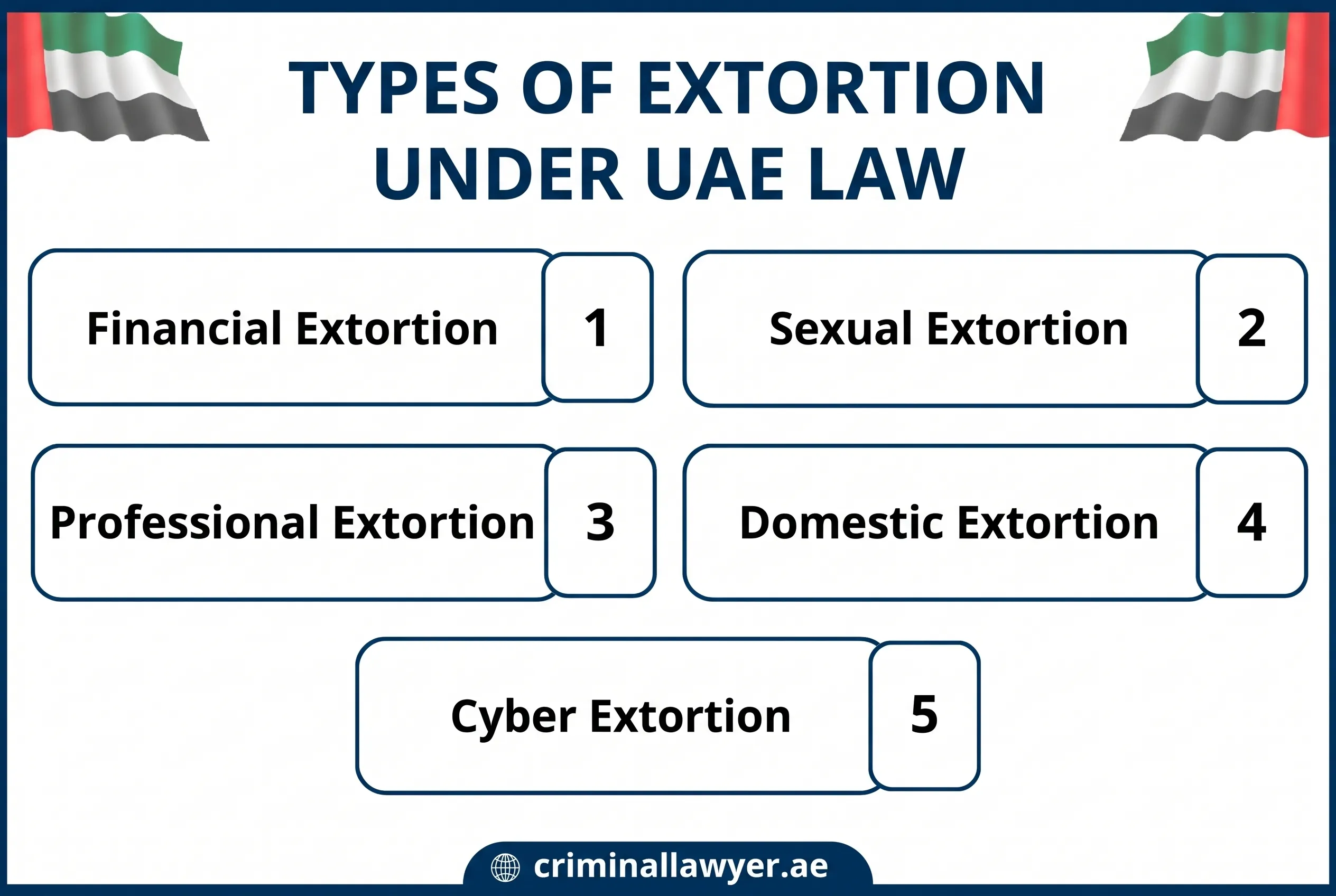
Extortion can be divided into several categories according to the extortionist’s purpose and the harm caused. Each category involves different methods of threats and coercion, including:
- Financial extortion: This occurs when someone threatens a victim and forces them to pay a specified amount of money by threatening to reveal secrets or personal information. It is often associated with the disclosure of private photographs or videos.
- Sexual extortion: This involves threatening to publish sexual information or images unless the victim meets the extortionist’s demands. This form of blackmail is particularly common on social media.
- Professional extortion: This occurs when a victim is threatened with damage to their professional reputation or career unless they comply with the extortionist’s demands.
- Family-related extortion: This involves threatening to harm the victim’s family members if the extortionist’s demands are not met.
- Online extortion: The extortionist uses social media, modern technology or the internet to carry out various forms of extortion and threaten the victim. It is one of the most common forms of this offence.
All these forms share a common feature: exploiting the victim’s personal or social vulnerability. For that reason, UAE law criminalises the various forms of extortion and prescribes deterrent penalties to protect individuals and society.
Penalties for Extortion under UAE Law
Through Federal Decree-Law No. 31 of 2021 on Crimes and Penalties, the UAE legislature established strict penalties for extortion because of its seriousness and its impact on the security of individuals and society. Article 404 provides that anyone who threatens another person, in writing, verbally or by any other means, to compel them unlawfully to do something or refrain from doing it is punishable by imprisonment or a fine.
The penalty becomes more severe if the threat involves committing a felony or concerns a person’s honour or property. In such circumstances, punishment may include several years of imprisonment and substantial financial fines.
The article also states that, under UAE law, extortion offences are not subject to a limitation period, meaning that a victim may file a complaint and claim their legal rights at any time as long as the evidence and elements of the offence are present.
Workplace Extortion under UAE Law
Workplace extortion is a form of abuse of influence or authority in which a person in a position of responsibility uses that position to force an employee to perform an unlawful act or give up one of their rights.
UAE law addresses such conduct under offences relating to public office. Articles 275 and subsequent provisions prescribe imprisonment and fines for abuse of authority or misuse of official position, and penalties may be increased where the conduct involves financial or non-financial extortion.
Penalties for Extorting Children in the UAE
UAE law places great importance on protecting minors from all forms of threats and exploitation. It therefore imposes stricter penalties for extorting children because of the serious psychological and social consequences. The Child Rights Law, known as Wadeema’s Law (Federal Law No. 3 of 2016), provides protection for children against exploitation and abuse, including all forms of extortion.
هل أنت في هذا الموقف فعلاً؟
اشرح قضيتك لفريق خدمة العملاء، ويتم توجيهك إلى محامٍ جنائي مرخّص في الإمارات يناسب نوع قضيتك وإمارتك واللغة التي تفضّلها.
اشرح قضيتك الآن عبر واتسابأو تعرّف على كيفية سير الاستشارة · المحتوى مراجَع قانونيًا من الدكتور المحامي محمد الرملاوي — قيد رقم 120635
Under the applicable legislation, penalties for extorting children in the UAE may include severe imprisonment and substantial fines, particularly when the offence is committed through information technology or the internet. The penalty may also be increased where the extortion causes actual harm to the child or is used to obtain financial or sexual benefits.
The UAE legislature thus emphasises that violations of children’s rights, whether through online or traditional extortion, will be met with strong deterrent measures intended to protect minors and society.
For a detailed explanation, read about penalties for extorting children under UAE law.
Online Extortion Crimes in the UAE
Online extortion in the UAE is among the common offences of the digital age. It involves conduct carried out over the internet or social media in which a victim is threatened with the publication of images, recordings or personal information in exchange for a financial or other benefit.
The UAE legislature addresses cybercrimes through Federal Decree-Law No. 34 of 2021 on Combating Rumours and Cybercrimes, which expressly criminalises the use of networks or digital platforms as a means of extortion.
See also our guide to penalties for online extortion and how to report extortion in the UAE.
The Role of a Lawyer in Extortion Cases in the UAE
An extortion cases lawyer provides comprehensive legal support to clients, helping them address these cases and protect their related rights. The lawyer’s role includes:
- Providing legal advice to help clients understand their rights and the procedures available to protect them from the consequences of extortion.
- Assisting in preparing and submitting an official complaint to the competent authorities, ensuring that relevant evidence is collected and attached to support the client’s account.
- Representing the client, whether they are the victim of extortion or the person accused, and taking the necessary procedural steps to assist them.
- Collecting evidence to support the client’s position, such as witness testimony, telephone call recordings, messages and any other material showing that the offence occurred.
- Informing victims of extortion about ways to protect themselves and how to respond if they are targeted.
Having an experienced criminal lawyer in the UAE who provides effective legal services can significantly influence the handling and outcome of an extortion case, as the lawyer performs the tasks needed to present the client’s position and pursue their rights.
Frequently Asked Questions
Is asking for money necessary for a threat to qualify as extortion?
A demand for money is not always necessary. Threats may seek another benefit or pressure someone to act against their will. Whether the conduct constitutes extortion depends on the words or actions used, the circumstances, and the legal provision that applies. The authorities must assess the evidence before deciding how it should be classified.
Should I pay someone who threatens to publish my private photos?
Avoid sending money or further personal material merely because someone is threatening you. Preserve messages, account details and other evidence, and consider reporting the threat promptly through official UAE channels. If you feel in immediate danger, contact the police. A licensed lawyer can help you understand the next steps for your circumstances.
Can a threat be investigated even if the threatened act never happens?
A threat can be legally significant even when the threatened disclosure or other harm does not take place. The relevant issue is whether the conduct meets the elements of an offence under the applicable law. Investigators may consider messages, recordings, witness statements and the surrounding circumstances, rather than relying only on whether the threat was carried out.
What evidence should I keep if threatening messages may disappear?
Keep any material you can lawfully preserve, including screenshots with dates, usernames, profile links, email headers and payment requests. Avoid altering or cropping the original evidence where possible. Some records may still be accessible through the relevant service or an official investigation, but their availability cannot be guaranteed. Seek advice on secure handling and reporting.
In conclusion, extortion under UAE law is treated as a serious offence because it directly threatens individual freedom and public safety, and the country responds to such conduct with firm legal measures.
The legislature has addressed this offence through Federal Decree-Law No. 31 of 2021 on Crimes and Penalties and Federal Decree-Law No. 34 of 2021 on Combating Rumours and Cybercrimes. These laws provide for penalties that may include severe imprisonment and substantial fines, particularly in cases of online extortion and the extortion of children.
If you are a victim of extortion or are facing threats through any means, you can contact us using the WhatsApp button at the bottom of the page for specialised legal advice to help you take an appropriate step with confidence and peace of mind.
Legal Disclaimer:
The information in this article is intended for general educational purposes and does not constitute legal advice. For advice tailored to your circumstances, consult a lawyer licensed in the United Arab Emirates.
Sources
- Federal Decree-Law No. 31 of 2021 on Crimes and Penalties.
- Federal Decree-Law No. 34 of 2021 on Combating Rumours and Cybercrimes.
- Child Rights Law (Wadeema’s Law) – Federal Law No. 3 of 2016.
- UAE Legislation Portal.
- UAE Ministry of Justice.

هل أنت في هذا الموقف فعلاً؟
اشرح قضيتك لفريق خدمة العملاء، ويتم توجيهك إلى محامٍ جنائي مرخّص في الإمارات يناسب نوع قضيتك وإمارتك واللغة التي تفضّلها.
اشرح قضيتك الآن عبر واتسابأو تعرّف على كيفية سير الاستشارة · المحتوى مراجَع قانونيًا من الدكتور المحامي محمد الرملاوي — قيد رقم 120635