

Legal review: Written and reviewed by a specialized legal team.
Last updated: 2026/08/6.
Category: UAE felonies law.
In the UAE judicial system, objection to an in absentia judgment in a criminal case is considered one of the fundamental rights that guarantee an individual a second chance to review the judgment issued against them in their absence. You may find yourself in a situation where you cannot attend court due to force majeure circumstances, and an in absentia judgment is issued against you. This is where objection comes in as a legal tool that protects your rights and gives you the chance to challenge this judgment and present your defenses before the court.
In this article, we will learn about the conditions and procedures related to objecting to an in absentia judgment in the UAE, and the importance of complying with the legal period for filing this objection, which contributes to achieving justice and protecting individuals’ rights at all stages of the criminal case.
This guide focuses on objection to an in absentia judgment in a criminal case when the judgment is issued in a misdemeanor or violation.
As for challenging criminal judgments in general, it may be done through opposition or appeal in criminal cases or other methods of challenge, depending on the type of judgment, how it was issued, and the judicial stage the case has reached. Therefore, the copy of the judgment must be examined before taking action, without being satisfied with describing it as an in absentia judgment without verifying the legal route available.
Were you surprised by an in absentia judgment issued against you and fear the consequences of sudden enforcement? Don’t let time run out and lose your right to defend yourself.
Or you can read the guide to learn the legal deadlines for objection first
جدول المحتوبات
Conditions for Objection to an In Absentia Judgment in a Criminal Case in the UAE
Verifying these conditions requires reviewing the copy of the judgment and the notification data, especially the date the notice reached the convicted person and the capacity recorded for the judgment. The available route of challenge may differ if the judgment was in presence, in absentia, or issued after a previous opposition.
Objection in this context means challenging by way of opposition. According to Article 229 of the UAE Criminal Procedure Law, the procedure is done by a report at the criminal registry of the Public Prosecution located within the jurisdiction of the court that issued the judgment, and the report specifies the date of the session set to consider the opposition.
Writing a memorandum containing the defenses and grounds helps organize the defense and present documents, but it does not replace completing the report procedure with the competent authority.
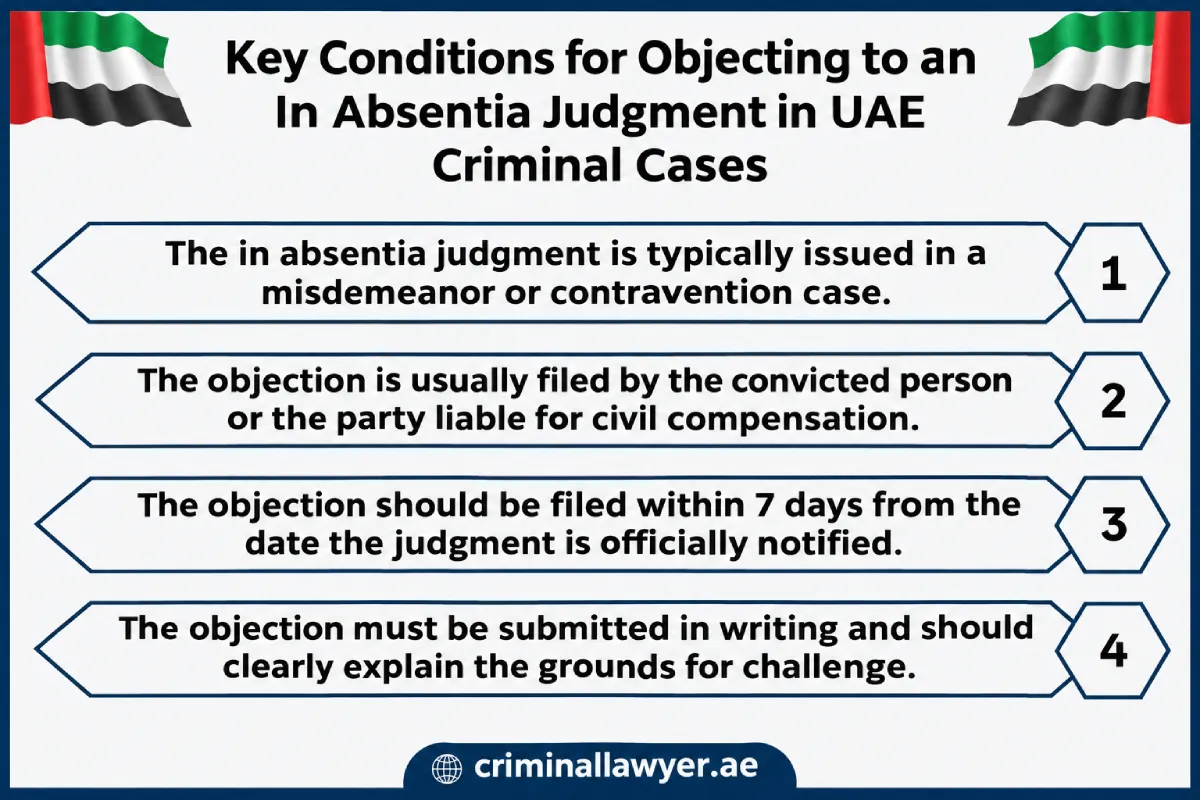
The conditions for objection to an in absentia judgment in a criminal case aim to ensure that the objection is lawful and fair, giving the convicted person the opportunity to defend their rights and have the judgment issued against them reviewed, and these conditions include:
- Type of judgment: The in absentia judgment must be issued in a misdemeanor or violation.
- Identity of the objector: The objector must be the convicted person or the person responsible for civil rights.
- Time period: The objection must be filed within 7 days from the date the judgment is notified to the convicted person or the person responsible for civil rights.
- Form of the objection: The objection must be submitted in writing, and must include the grounds for challenging the judgment.
The experience of a lawyer for in absentia judgment cases in the UAE will change the course of the case, so you should look for a specialized lawyer.
Steps for Objection to an In Absentia Judgment in a Criminal Case in the UAE
Before filing an opposition against an in absentia judgment, it is advisable to prepare the preliminary data and documents that help complete the procedure and review the case, most importantly:
هل أنت في هذا الموقف فعلاً؟
اشرح قضيتك لفريق خدمة العملاء، ويتم توجيهك إلى محامٍ جنائي مرخّص في الإمارات يناسب نوع قضيتك وإمارتك واللغة التي تفضّلها.
اشرح قضيتك الآن عبر واتسابأو تعرّف على كيفية سير الاستشارة · المحتوى مراجَع قانونيًا من الدكتور المحامي محمد الرملاوي — قيد رقم 120635
- The case number and the judgment number, if available.
- A copy of the in absentia judgment.
- The date of notification of the judgment and the method of notification.
- The details of the court that issued the judgment.
- Proof of the convicted person’s identity.
- The power of attorney if the procedure is submitted by a representative.
- Documents related to the defense on the substance of the case.
Registering the objection does not mean the court has accepted the defenses or canceled the judgment; rather, after registration the stage of considering the opposition and verifying that it meets the formal conditions begins, and then the court re-examines the case with respect to the opposing party.
The proof of registering the report must also be kept and the date of the first session known precisely, because the opposing party’s failure to attend the first session results in the opposition being treated as if it had not been filed, and no further opposition is accepted from them against the judgment issued in their absence at that session.
The steps of objection aim to ensure that the objection is valid, in order to reach the desired result, and these steps are:
- Filing the objection: The objection must be submitted to the criminal registry administration at the Public Prosecution located within the jurisdiction of the court that issued the judgment, and it must be submitted in writing and include the grounds for challenging the judgment.
- Required attachments: The objection must be accompanied by a copy of the in absentia judgment issued against the convicted person.
- Setting the session date: After the objection is filed, the Public Prosecution registry sets a date for the session to consider the opposition, and the objector is notified of the date set to consider the objection.
- Attending the session: The objector must attend the first session to consider the opposition, and if the objector does not attend, the opposition is considered void.
- Discussing the grounds of the challenge: The court discusses the grounds of the challenge submitted by the objector, and the evidence and testimonies supporting the grounds of the objection are presented.
- Issuing the new judgment: After discussing the grounds of the challenge, the court issues a new judgment based on the discussion and the evidence presented.
- Notifying the parties: All parties concerned are notified of the new judgment issued by the court.
From here we conclude that you must know when to file a criminal case in the UAE?
What Is the Period for Objection to an In Absentia Judgment in the UAE?
The period for objection to an in absentia judgment in the UAE is determined according to Article 229 of Federal Decree-Law No. 38 of 2022, which includes the UAE Criminal Procedure Law. There are several important points, which are:
- Objection period: The objection to the in absentia judgment must be filed within 7 days from the date the judgment is notified to the convicted person or the person responsible for civil rights.
- Start of the period: The seven-day period starts from the date the judgment is notified, not from the date it is issued.
- Notification procedures: Notification is carried out by the Public Prosecution or through approved legal methods.
- Special cases: If the judgment was not properly notified or there was a legitimate excuse that prevented the convicted person from knowing about the judgment, the period may be extended at the court’s discretion.
- Importance of complying with the period: Complying with the specified period for objection is necessary to ensure the objection is accepted; if the objection is filed after the legal period has expired, it may be rejected in form without considering its substance.
When calculating the period for objection to a criminal judgment, a distinction must be made between the date the judgment was issued and the date it was notified. The seven-day period linked to the opposition starts from the convicted person’s notification of the judgment, so the notification data recorded in the case file should be consulted instead of relying on the date of verbal knowledge or an informal message.
When there is a problem with the notification, its validity, the date it occurred, and its effect on the start of the deadline must be verified. An automatic extension of the objection period should not be assumed, because determining whether the period has started or expired depends on the notification data and the procedures recorded in the file.
It is preferable to take action as soon as you learn of the judgment and not wait until the end of the period, especially if you need to obtain a copy of the judgment or deal with a judicial authority different from the one through which the case was inquired about. Here, a criminal cases lawyer in the UAE will help you a lot with this.
Frequently Asked Questions
How long is the opposition period for an in absentia judgment?
The opposition period for an in absentia judgment in the UAE is seven days from the date the judgment is notified to the convicted person or the person responsible for civil rights, and the objection must be filed within this period to ensure it is accepted by the court; if the objection is not filed on time, it may be rejected in form without considering its substance.
Can the objection period be extended in special cases?
Yes, the objection period can be extended in special cases if the judgment was not properly notified or if there was a legitimate excuse that prevented the convicted person from knowing about the judgment, and this is done at the discretion of the court considering the objection.
In what cases can an in absentia judgment be challenged?
An in absentia judgment can be challenged in the following cases:
1. The judgment was not notified to the convicted person.
2. There was a legitimate excuse that prevented the convicted person from attending.
3. There are legal or factual errors in the judgment.
4. The evidence relied on by the court was insufficient.
How do I know whether the objection to the judgment has been accepted?
The initial registration of the objection can be known by obtaining proof that the report was filed, determining the request or opposition number, and the appearance of the date of the session set to consider it. However, registering the procedure does not mean a final decision accepting it or canceling the judgment has been issued.
What proves that an opposition was filed against an in absentia judgment?
Filing an opposition against an in absentia judgment is proven by registering the report at the competent criminal registry and obtaining the details of the procedure and the session set to consider it. Setting the session date in the report is considered notice to the opposing party, even when the report is filed by their legal representative.
In conclusion, objection to an in absentia judgment in a criminal case is a vital legal tool that ensures justice and protects individuals’ rights in the UAE judicial system. By understanding the conditions of objection and the procedures of challenge, the convicted person can obtain a second chance to have the judgment issued against them reviewed, which enhances the integrity of the judiciary. Therefore, it is necessary to comply with the specified period and take the correct legal steps to ensure the objection is accepted.
If you need online legal consultations specialized in this field, our office provides you with the necessary support to ensure the best results in your legal cases. Contact us now through our numbers on the page Contact Us.
For more related details, see: Dubai Court of Cassation criminal judgments.

هل أنت في هذا الموقف فعلاً؟
اشرح قضيتك لفريق خدمة العملاء، ويتم توجيهك إلى محامٍ جنائي مرخّص في الإمارات يناسب نوع قضيتك وإمارتك واللغة التي تفضّلها.
اشرح قضيتك الآن عبر واتسابأو تعرّف على كيفية سير الاستشارة · المحتوى مراجَع قانونيًا من الدكتور المحامي محمد الرملاوي — قيد رقم 120635