
Legal Review: Written and reviewed by a specialized legal team.
Last Updated: August 19, 2026.
Category: UAE Criminal Law.
In a real case that reached the Federal Supreme Court, the dispute was not limited to whether the words amounted to insult or defamation; the accused argued that the complaint was filed after the three-month deadline had expired.
In Criminal Appeal No. 722 of 2024, issued at the session of 10 December 2024, the court held that this was a material defense requiring an examination of the date on which the victim learned of the crime and its perpetrator, and it overturned the judgment because that defense had not been answered.
This case shows that the conditions for filing a defamation case are no less important than the content of the insult itself; the messages and evidence may exist, yet the complaint can still be affected by a mistake regarding the deadline, the capacity to file, or the way the incident is proven.
Were you insulted or defamed, and are you afraid of losing your right because of the difficulty of proving the offense? Do not let the person who wronged you escape punishment.
جدول المحتوبات
Conditions for Filing a Defamation Case Under UAE Law
The first condition is that the incident involves an act that can legally be characterized as insult or defamation, not merely a disagreement or an unwelcome remark.
The most important conditions for filing a defamation case that should be examined before submitting the complaint are the following:
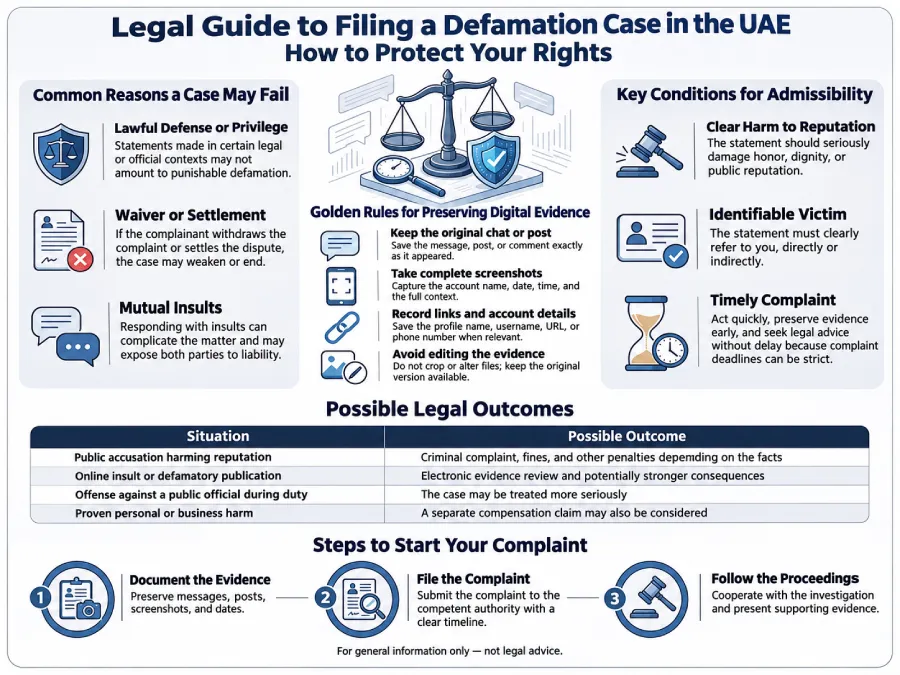
- The existence of a statement or incident with legal significance: the content of the statement, message, or post must be something that can harm honor or reputation under the legal characterization of the incident.
- The insult must be directed at an identifiable person: it must be possible to understand that the victim is the person targeted by the words complained of.
- The complaint must come from someone entitled to file it: that is, the victim, the person who legally stands in the victim’s place, or the victim’s special attorney under Article 11.
- Compliance with the three-month deadline: it runs from the day the victim learns of both the crime and its perpetrator.
- Evidence that can be examined: such as a message, post, recording, testimony, or electronic evidence that can be presented to the investigating authority.
- The ability to attribute the act to the accused: the legal name of the offender does not have to be known at the moment of reporting, but proving that the account, number, or means of communication belongs to a specific person becomes a key issue when the accusation is attributed.
- The incident must not be covered by a legal reason that negates criminal liability: for example, statements made within the limits of the right of defense before the courts or investigating authorities.
- Among the conditions for filing a defamation case is that the case must not have lapsed because of a waiver or another legal cause affecting its continuation.
Knowing the identity of the accused should not be confused with the victim’s right to report. If the insult came from an anonymous account or an unknown number, you can submit whatever information is available and leave the technical investigation procedures to the competent authorities; however, linking the account to its owner remains an important part of the proof.
In addition, when the abuse takes place through WhatsApp or another social media platform, attention shifts to the rules on cybercrimes and digital evidence. You can refer to the penalty for online insult and defamation in the UAE for details on the penalty.
The Legal Time Limit in Insult and Defamation Crimes
This is one of the most serious procedural conditions in insult and defamation cases. Article 11 expressly provides that a complaint is not accepted after three months from the day the victim learns of the crime and its perpetrator, unless a provision states otherwise.
Therefore, it is not always enough to look at the date of the message or post alone. The provision ties the start of the period to two elements together: knowledge of the crime and knowledge of its perpetrator. The abuse may be apparent immediately, while the identity of the owner of an anonymous account becomes clear only later; in that case, proving the actual date of knowledge becomes a factual question governed by the documents and investigations in the case.
In practical terms, you should keep everything that helps establish the timeline, such as the date the message was received, the date the post was viewed, the link or account name, and any correspondence or procedures that led to identifying its owner.
The Federal Supreme Court stressed the importance of this condition in Criminal Appeal No. 722 of 2024, session of 10 December 2024, when it treated the plea that the complaint was filed after the three months had expired as a material defense that the trial court must examine and answer.
Capacity as One of the Conditions for Filing a Defamation Case: Who May File?
Insult and defamation are crimes for which initiating criminal proceedings requires a complaint from the person who legally holds that right, and Article 11 of Federal Decree-Law No. 38 of 2022 Promulgating the Criminal Procedure Law permits it to be filed by the victim, the person who legally stands in the victim’s place, or the victim’s special attorney.
Article 14 also addresses the case of a victim who has not completed fifteen years of age or who has a mental disability, in which case the complaint is filed by the person who has guardianship over them.
An extremely important procedural point arises here: a general power of attorney is not a safe substitute for a special power of attorney when filing this complaint. In Criminal Appeal No. 1777 of 2023, session of 9 September 2024, the Federal Supreme Court held the case inadmissible where the complaint was submitted by an agent relying on a general rather than a special power of attorney, on the basis that Article 11 requires that the victim’s will be expressed by the person who legally holds the right.
Conditions for Proving the Incident and Admitting Digital Evidence
UAE law recognizes electronic evidence as evidence in criminal proof, but its strength in each case depends on its integrity and on the ability to verify its source and attribute it to the person concerned.
The investigating authority may need to examine the original conversation, the device used, the account or number data, and any other technical elements that help verify the evidence.
In practice, it is best to observe the following points when preparing digital evidence before filing the complaint:
- Keep the original conversation on the phone or device, and do not rely on a forwarded copy when the original is available.
- Keep the screenshot unedited and uncropped so that context is not lost, showing the account name or number, the date, and the time wherever possible.
- Save the post link or the username and account details if the insult or defamation occurred on a social media platform.
- Do not delete the original message if it can be kept, because its presence may make technical examination easier if the authenticity or content of the image is disputed.
- Keep the full conversation when necessary, because a statement may not be understood in its proper legal sense if it is isolated from what came before or after it.
- Identify the owner of the account or number as far as possible, because proving that a statement came from a particular account differs from proving that the accused was in fact the person using that account at the time of the incident.
This does not mean that a screenshot alone is legally rejected. More precisely, it may be evidence or a presumption that can be relied upon among the elements of the case, while its strength depends on the circumstances of the incident and on how far its authenticity and the attribution of the account to its owner are disputed.
The Law on Combating Rumors and Cybercrimes itself stresses the importance of the integrity of digital evidence, as it defines digital evidence as electronic information that has probative force or value and that can be collected and analyzed using technical means.
Obstacles to the Admissibility of an Insult and Defamation Case
Not all reasons for a complaint’s failure are of a single legal type. Some situations lead to the complaint being inadmissible on procedural grounds, others negate the crime from the outset, and in others the prosecution considers the evidence insufficient to proceed with the case.
The most important situations that affect the conditions for filing a defamation case are as follows:
1. Filing the complaint after the three-month period has expired
The deadline is one of the most important conditions for filing a defamation case. Article 11 of the Criminal Procedure Law requires the complaint to be filed within three months of the day on which the victim learns of the crime and its perpetrator, unless a special provision states otherwise.
For this reason, delay without a reason related to not knowing who committed the act may lead to a plea that the complaint is inadmissible.
2. Filing the complaint by someone who lacks capacity
Among the conditions for filing a defamation case, the law requires that the complaint come from the victim, from someone who legally stands in the victim’s place, or from the victim’s special attorney. Particular attention must therefore be paid to the type of power of attorney when a complaint is filed through a lawyer or an agent, and not only to the existence of a power of attorney in general.
3. The statement is insufficient to constitute insult or defamation
Not every offensive or provocative remark is insult or defamation in the legal sense. The characterization of a statement remains tied to its content and the context in which it was made.
The Federal Supreme Court confirmed this in Criminal Appeal No. 619 of 2022, issued on 3 January 2023, when it held that praying for illness to befall a person, although inappropriate, does not in itself amount to the legal meaning of insult unless the statement contains cursing, the attribution of a defect, or an expression that demeans the person or injures their standing.
4. The statement was made within the limits of the right of defense
Some statements may be made during a court case or an investigation, and here the legal assessment differs from abuse that occurs in daily life or on social media.
هل أنت في هذا الموقف فعلاً؟
اشرح قضيتك لفريق خدمة العملاء، ويتم توجيهك إلى محامٍ جنائي مرخّص في الإمارات يناسب نوع قضيتك وإمارتك واللغة التي تفضّلها.
اشرح قضيتك الآن عبر واتسابأو تعرّف على كيفية سير الاستشارة · المحتوى مراجَع قانونيًا من الدكتور المحامي محمد الرملاوي — قيد رقم 120635
Article 429 of the Crimes and Penalties Law, issued by Federal Decree-Law No. 31 of 2021, provides that there is no crime in what the defense of litigants contains, orally or in writing, before the courts or investigating authorities, of defamation or insult, provided it remains within the limits of the right of defense.
The law was issued on 20 September 2021, and one of its most recent amendments is Federal Decree-Law No. 13 of 2025.
This exception does not mean that any abuse written in a court memorandum automatically becomes permissible; rather, it must be connected to the exercise of the right of defense and remain within its limits.
5. Waiver of the complaint
The Criminal Procedure Law allows the victim to waive an insult or defamation complaint. Article 17 provides that the person who filed the complaint may waive it before a final judgment is issued, and the waiver results in the extinguishment of the criminal case in accordance with the rules set by the law.
For this reason, a distinction must be made between archiving a report due to weak evidence and the extinguishment of the case as a result of a valid waiver of the complaint.
6. Inability to attribute the account or number to the accused
The content of a message may be clear and abusive, yet a different question remains: who sent it?
If the accused denies that the account or number belongs to them, or denies using it at the time of the incident, the ownership of the account or device may become a central issue in the investigation. Keeping the original data, the number, the link, and the full conversation therefore helps make verification easier.
7. Responding to an insult with a similar insult
A mutual insult does not automatically mean the report is dropped or inadmissible. Article 152 of the Crimes and Penalties Law gives the judge the power to grant pardon in certain misdemeanors if the incident involves insult or assault and the aggression was mutual. It is therefore at the court’s discretion and not an automatic rule that ends the case as soon as it is proven that both parties exchanged abuse.
It is therefore best for a person who is weighing the conditions for filing a defamation case to avoid responding with similar abusive language, and instead to preserve the evidence and follow the legal path.
Legal Procedures for Filing a Defamation Case in the UAE
The procedure begins, after confirming the conditions for filing a defamation case, with submitting a complaint; it does not begin with the victim bringing the criminal case themselves. The Public Prosecution is the body legally competent to bring and conduct the criminal case, while the victim submits the complaint and presents the evidence they have.
To avoid losing any procedural requirement, the steps can be arranged as follows:
- Document the incident immediately: Keep the messages, posts, clips, or witness details, and do not rely on memory alone to determine the date of the incident.
- Determine the date you learned of the crime and its perpetrator: This step is essential for calculating the three-month period set out in Article 11 of the Criminal Procedure Law.
- Verify the capacity of the person filing the complaint: If the victim will file it personally, there is no problem in this respect; if it is filed through an agent, attention must be paid to the requirement of a special agent in Article 11.
- Prepare the evidence in its original form as far as possible: Keep the phone, conversation, link, account, or original message, along with any screenshots taken at the time of the incident.
File the complaint with the competent authority: Article 12 of the Criminal Procedure Law provides that the complaint may be submitted to the Public Prosecution or to one of the judicial police officers, and in cases of flagrante delicto it also allows it to be submitted to the public officer present.
- Explain the incident in a clear chronological order: It is useful to state the date of the incident, how the abuse reached the victim, what the statement complained of is, which account or number was used, and when its owner’s identity became known.
- The stage of collecting inferences and evidence begins: Article 36 of the Criminal Procedure Law requires judicial police officers to accept reports and complaints, obtain the necessary clarifications, carry out whatever helps establish the facts, and take precautionary measures to preserve the evidence.
- The Public Prosecution disposes of the file according to the evidence: If the Public Prosecution finds, in misdemeanors and violations, that there is no ground to proceed with the case, Article 119 allows it to issue an order to archive it. If the evidence against the accused is sufficient, Article 121 allows the case to be referred to the competent criminal court.
- The court examines the incident, the evidence, and the defenses: After referral, the court assesses whether the incident is proven and attributable to the accused, and whether the statements meet the legal description of the crime.
This sequence shows why it is advised not to treat filing a report, or the conditions for filing a defamation case behind it, as a mere formality; the soundness of the deadline, the capacity, the evidence, and the attribution of the account to its owner can all affect the later course of the case.
How Does Meeting the Conditions Affect the Compensation Path?
Meeting the conditions for filing a defamation case and the criminal complaint does not automatically mean a financial compensation award. Compensation has its own legal conditions and elements, including proof of harm and its causal link to the act complained of.
However, preserving the evidence and filing the complaint properly may have an important effect in documenting the incident and in any related civil path later on.
You can find the details in compensation for damage under UAE lawto learn more about the details.
Legal Penalties for Insult and Defamation in the UAE
These penalties apply only once the conditions for filing a case provided for by UAE law are met. Depending on the nature of the act and the means used to commit it, the penalties range between imprisonment and the fines set out in Articles 425, 426, and 427 of Federal Law No. 31 of 2021, as detailed below:
- Imprisonment of up to two years or a fine of up to AED 20,000 for publicly attributing to a person an incident that makes them liable to punishment or exposes them to contempt.
- The penalty is aggravated if the defamation is committed against a public employee during the performance of their duties, or if the act is offensive to honor or reputation, and includes imprisonment and a fine or one of the two penalties.
- Imprisonment of up to one year or a fine of up to AED 20,000 for public insult without attributing a specific incident.
- Imprisonment of up to six months or a fine of up to AED 5,000 if the insult or defamation is committed by telephone or in the presence of the victim and a third party.
- A fine of up to AED 5,000 for insult or defamation face to face with no others present, or through a private message.
- The penalty is aggravated in the preceding cases if the act targets a public employee, is offensive to honor, or is committed with an unlawful motive.
- The use of means of publication such as newspapers or printed materials is considered an aggravating circumstance because of the wide impact of the act.
The Role of the Lawyer in Insult and Defamation Cases
A lawyer’s involvement is an essential element in insult and defamation cases, given their delicate legal nature and procedural details that require familiarity with criminal law and with the interpretation of provisions related to personal freedoms and individual rights. The lawyer’s role in insult and defamation cases includes the following:
- Providing an online legal consultation and assessing the feasibility of filing the complaint in light of the conditions for filing a defamation case set out by the law.
- Drafting the complaint in a legally sound manner, in a legal style that includes the elements needed to prove the crime, taking care to include the facts and evidence in a way that persuades the investigating authority of the importance of initiating the case.
- Attaching the admissible legal evidence and presenting it to the Public Prosecution in an organized manner, whether electronic messages, recordings, posts, or witness testimony.
- The lawyer drafts the legal pleadings precisely and ensures compliance with the legal procedures governing the filing of the case, which protects the client’s rights from any violations.
- Representing the client before the investigating authorities and the court, whether in the preliminary investigation or before the court, presenting the appropriate defense and responding to the opponent’s pleas, relying on legal provisions and judicial precedents.
- The lawyer follows the outcome of the case and appeals the judgment if the client’s interest requires it, taking care to respect the legal deadlines and the formal procedures required for appeal.
Frequently Asked Questions About the Conditions for Filing a Defamation Case
Does the three-month period start from the day the statement was published?
Not in every case. Article 11 of the Criminal Procedure Law ties the period to the day the victim learns of both the crime and its perpetrator. Determining the date of knowledge can therefore be important, especially when the act came from an anonymous account.
Can I file a report if I do not know who owns the account?
Yes. Not knowing the real name of the account owner does not necessarily prevent you from starting the report with the information you have. However, identifying the person responsible for the account remains an important issue in proof, and the competent authorities may carry out the necessary investigation procedures.
What is the difference between insult and defamation under UAE law?
Insult is abuse without attributing a specific incident, while defamation involves accusing the victim of an act that calls for punishment or for which society holds them in contempt.
Is a screenshot enough to file the complaint?
It can be used among the evidence, but it is not necessarily the only sufficient element in every case. Article 65 of the Law on Combating Rumors and Cybercrimes gives digital evidence its probative force in criminal proof, while the assessment of the evidence's integrity and attribution depends on the circumstances of each incident.
Should I keep the original WhatsApp message?
It is best to keep it and not delete it. No provision makes deleting the message alone an automatic ground for inadmissibility of the complaint, but having the original conversation may make technical verification of the evidence, its source, and its context easier.
Can a lawyer file the complaint with a general power of attorney?
Article 11 of the Criminal Procedure Law expressly refers to the special agent when identifying who may file the complaint. The content of the power of attorney and its validity for this procedure should therefore be reviewed, rather than assuming that any general power of attorney is enough.
Does responding to an insult with another insult lead to the case being archived?
Not automatically. Article 152 of the Crimes and Penalties Law gives the judge a discretionary power to grant pardon where an insult misdemeanor was mutual, but it does not provide that the report becomes inadmissible merely because the other party responded with a similar insult.
Where is an insult and defamation complaint filed?
Under Article 12 of the Criminal Procedure Law, it may be submitted to the Public Prosecution or to one of the judicial police officers, with a special provision for cases of flagrante delicto.
The steps for reporting through digital services and electronic platforms are explained separately in [How to Report Cybercrimes in the UAE] to avoid duplicating content between pages on the site.
Can an insult and defamation complaint be waived after it is filed?
Yes. Article 17 of the Criminal Procedure Law allows the person who filed the complaint to waive it before a final judgment is issued, which results in the extinguishment of the criminal case under the conditions set out by the provision.
What happens if the Public Prosecution finds the evidence insufficient?
If the Public Prosecution finds there is no ground to proceed with the case, Article 119 of the Criminal Procedure Law allows it to issue an order to archive it in misdemeanors and violations. If the evidence is sufficient, Article 121 governs its referral to the competent criminal court.
The strength of an insult and defamation complaint begins with meeting the conditions for filing a defamation case before submitting it. The most important things to verify are that the complaint is filed within the legal period, that it comes from someone with capacity, that the original evidence is preserved, and that the message or account can be attributed to the perpetrator, in addition to making sure that the statements themselves can meet the legal description of insult or defamation.
In electronic cases, UAE law gives digital evidence probative force in criminal proof, but preserving the original conversation, the account data, and the full context of the messages helps strengthen the evidentiary side and makes technical verification easier.
Contact us through the Contact Us page and request your legal consultation from a criminal lawyer in the UAE.
You may also be interested in: Rulings on Defamation and Slander in the UAE.

هل أنت في هذا الموقف فعلاً؟
اشرح قضيتك لفريق خدمة العملاء، ويتم توجيهك إلى محامٍ جنائي مرخّص في الإمارات يناسب نوع قضيتك وإمارتك واللغة التي تفضّلها.
اشرح قضيتك الآن عبر واتسابأو تعرّف على كيفية سير الاستشارة · المحتوى مراجَع قانونيًا من الدكتور المحامي محمد الرملاوي — قيد رقم 120635