
Legal review: Written and reviewed by a specialized legal team.
Last updated: 2026/08/20.
Category: UAE criminal law.
A defense memo against prosecution appeal is used when the public prosecution appeals a judgment issued in the accused’s favor, which is most evident when an acquittal is appealed.
Here the defense does not start from scratch; it starts from the judgment that has already been issued, examines its reasoning, then compares it with the prosecution’s grounds of appeal and answers them point by point.
The UAE Criminal Procedure Law gives the public prosecution the right to appeal criminal judgments issued by the courts of first instance, and the effects of appeals in criminal cases in the UAE differ according to who filed them and the judgment under appeal.
The law also sets a special safeguard for acquittals, as a judgment of acquittal may be overturned only by unanimity under Article 241 of Federal Decree-Law No. 38 of 2022 Issuing the Criminal Procedure Law.
For this reason, it is not enough to copy the defense memorandum submitted before the court of first instance. The case needs a memorandum addressed to the appeal itself, one that understands what the prosecution objects to while preserving the grounds that carried the acquittal.
Did you receive an acquittal and were surprised by the public prosecution appealing it? Don’t let fear of losing your acquittal take over.
Contact a criminal appeal lawyer nowOr you can keep reading to learn how to build your memorandum step by step
Quick summary: Build the memorandum on three pillars: the soundness of the judgment under appeal, a direct response to the prosecution’s grounds, and what the case papers contain that supports keeping the judgment.
جدول المحتوبات
What is a defense memo against prosecution appeal?
It is the memorandum submitted by the accused or his lawyer before the court of appeal to respond to the appeal filed by the public prosecution against the judgment issued by the court of first instance. In this case the prosecution is the appellant, and the accused is the respondent.
This memorandum differs from the criminal judgment appeal memorandum that the accused submits himself; in the first case he defends an existing judgment issued in his favor, while in the second he is the one asking for a change to the judgment he did not accept.
This difference shows in the way of writing. A defense memo against prosecution appeal does not need to repeat everything said at first instance; it needs a clear answer to two questions: Why was the judgment under appeal correct? And why are the prosecution’s grounds not enough to change it?
What happens if the prosecution appeals an acquittal?
An acquittal does not disappear merely because an appeal is registered. The court of appeal examines the case within the legal framework prescribed for it, hears the grounds of appeal and the other parties, then rules after reviewing the papers.
Article 241 gives the court, when the appeal is filed by the public prosecution, the power to uphold, overturn, or modify the judgment against the accused or in his favor. But it requires unanimity to overturn an acquittal.
In practice, this means that dealing with a prosecution appeal must be serious even if the acquittal was issued on strong grounds. What is required is not only defending the operative part of the judgment, but explaining the soundness of the basis on which it was built.
Why is the unanimity requirement important?
The unanimity requirement protects an acquittal from being overturned by only a majority of the panel’s members. The Federal Supreme Court has confirmed that an appellate judgment overturning an acquittal must state that it was issued unanimously, and it ruled a judgment void where this requirement was not established.
This does not mean the defense should be limited to relying on this requirement. It plays its role as a procedural safeguard, while the main task remains responding to the grounds of appeal and showing that the judgment is sound in law and in fact.
What should be reviewed before writing the memorandum?
Start with the file itself, not with models published online. Criminal cases differ in facts, evidence, and elements, and a defense suited to one case may be completely unproductive in another.
1. Review the judgment under appeal in full
Read the reasons before the operative part. Determine why the court of first instance reached acquittal or the judgment the prosecution is challenging. The reason may be the absence of an element of the crime, weak evidence, contradictory testimony, lack of proven intent, or the nullity of a material procedure.
Extract the decisive sentences from the judgment, then link each reason to the evidence the court relied on. This work helps turn the memorandum from general talk into a defense tied to the real judgment.
2. Examine the prosecution’s grounds of appeal
Determine whether the prosecution faults the judgment for an error in applying the law, flawed reasoning, a shortcoming in assessing evidence, or ignoring a fact it considers essential.
Write each ground on a separate line while preparing. Then place under it the defense’s answer and the document or part of the judgment that supports it. This way a defense memo against prosecution appeal is organized from the start.
The choice of the appropriate response varies from case to case; the defenses on appeal of a criminal judgment may relate to the soundness of the procedures, the assessment of evidence, or whether the elements of the crime are met, depending on the facts of the file.
3. Go back to the investigation and session records
Match what the grounds of appeal say against the original papers. Review the statements of the accused and witnesses, technical reports, documents, seizure records, and any expert opinion or recording that entered the case.
Look for the fine differences. The appeal may cite evidence in a way that does not reflect its full content, or the court of first instance may already have discussed it and explained why it was not relied upon.
4. Identify the legal elements of the crime
Link the facts to the provision on which the charge rests. If one of the elements is not established, explain that directly. Do not fill the memorandum with defenses unrelated to the description of the crime or the reasons for the judgment.
How to write a defense memo against prosecution appeal in the UAE
Follow an order that lets the judge understand the defense’s position quickly. There is no single mandatory format for the memorandum, but an organized structure makes the arguments easier to read and review.
First: Write the court and case details accurately
Start with the name of the court and the criminal circuit, then identify the parties to the appeal and their capacities, and write the appeal number, the case number, and the hearing date.
The heading can be arranged as follows:
………… Court of Appeal – Criminal Circuit
Memorandum in defense of Mr. ………… – respondent
Against the Public Prosecution – appellant
In Appeal No. ………… of …………
Scheduled for hearing on ../../….
Use the description found in the case file and do not copy titles from models that belong to another country or judicial authority.
Second: Define the judgment under appeal
State the court that issued it, its date, the case number, and its operative part as far as needed. If the judgment was an acquittal, make that clear from the start.
Do not be long here. It is enough for the reader and the court to know what judgment is under appeal and what the prosecution asks to change.
Third: Summarize the productive facts
Present only the facts that serve understanding of the dispute. Start with what was attributed to the accused, then summarize the course of the case up to the judgment under appeal, without copying investigation records or retelling events that do not affect the grounds of appeal.
This approach, which is also used on the web, helps the reader grasp the situation quickly before reaching the detailed defenses.
Fourth: Arrange the defense according to the grounds of appeal
Make each ground of the prosecution a sub-heading or a separate point. Then answer directly beneath it.
Use a simple order:
- Prosecution’s ground of appeal: What does it object to?
- Position of the judgment: What did the court of first instance decide on it?
- Defense response: Why does the objection not undermine the judgment’s reasoning?
- Support from the papers: Where does this appear in the file?
This order prevents scattering and ties a defense memo against prosecution appeal to what the court will decide, instead of becoming a collection of memorized legal phrases.
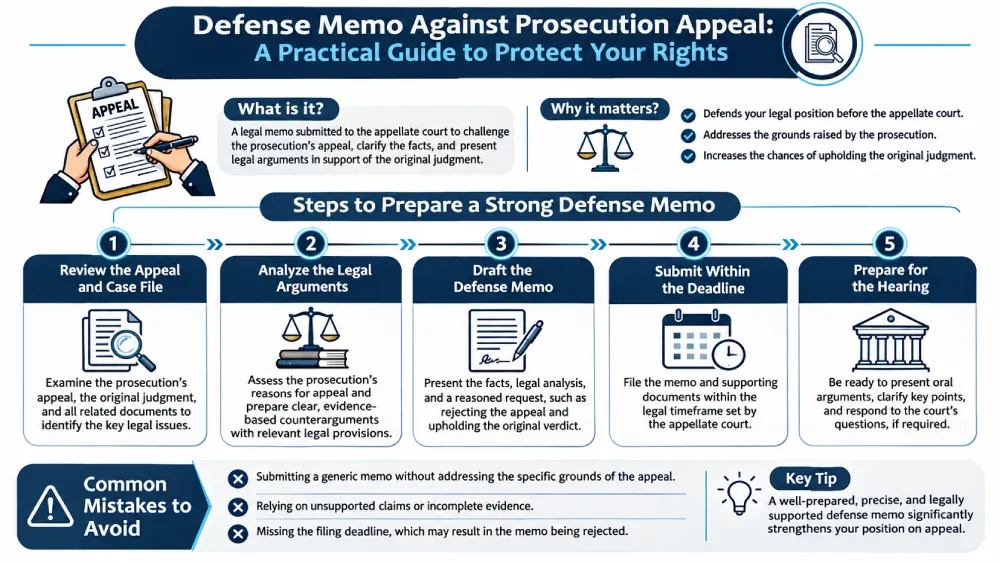
How do you respond to the prosecution’s grounds of appeal?
Start with the strongest point, not the longest. If the appeal rests on a single piece of evidence the prosecution sees as decisive, discuss that evidence in its place and show why it is insufficient or why the court of first instance’s assessment of it was sound.
Hold on to the soundness of the judgment’s reasoning
Explain how the court reached its result. If the judgment discussed the evidence, weighed it, and explained the reason for doubt about attribution, highlight that. And if it based the acquittal on the absence of a legal element, begin with the provision and the facts that prove it is not met.
Do not settle for the phrase “we adhere to the grounds of the judgment under appeal”. Add what makes that adherence understandable and convincing.
Discuss the insufficiency of the prosecution’s evidence where it applies
The court may rule for acquittal when it doubts the soundness of attributing the charge or the evidence of guilt is insufficient, but UAE case law requires that the judgment show it examined the case and considered its circumstances and evidence, not that it ignore a material piece of evidence and then declare doubt in a general way. This principle has appeared in the case law of the Federal Supreme Court.
So use the idea of doubt in a practical way. Show where the contradiction lies, what the evidence does not prove, and why a reasonable possibility remains that the papers do not allow to be excluded.
هل أنت في هذا الموقف فعلاً؟
اشرح قضيتك لفريق خدمة العملاء، ويتم توجيهك إلى محامٍ جنائي مرخّص في الإمارات يناسب نوع قضيتك وإمارتك واللغة التي تفضّلها.
اشرح قضيتك الآن عبر واتسابأو تعرّف على كيفية سير الاستشارة · المحتوى مراجَع قانونيًا من الدكتور المحامي محمد الرملاوي — قيد رقم 120635
Referring to the UAE criminal judicial principles and rulings helps in understanding how courts handle the assessment of evidence and defenses, instead of relying on general phrases about doubt or acquittal.
Show the absence of the elements of the crime if that is the basis of acquittal
Identify the disputed element, then link it to the incident. It may concern the material act, criminal intent, the accused’s connection to the act, or a special condition required by the penal provision.
Avoid ready-made phrases such as “absence of both the material and moral elements” unless you explain how each element was absent. One specific sentence adds more value to the memorandum than ten general phrases.
The mental element needs special care when the crime is based on intent, because determining criminal intent in UAE judgments depends on the nature of the accusation and the facts the court derived from the evidence.
Handle contradictions in the evidence without exaggeration
Mention the contradiction that matters, then explain its effect. Not every minor difference between witness statements brings down the accusation. Focus on the contradiction that touches the basic incident, the identity of the perpetrator, the sequence of events, or the significance of the evidence.
Check the soundness of the procedures when there is a real reason
Review the deadlines, notices, and procedures that affect the case. The Criminal Procedure Law provides that an appeal is made by a statement at the criminal registry within 15 days from the date specified in Article 234, and it gives the Attorney General 30 days from the issuance of the judgment to appeal.
Do not include a formal plea merely because it appears in an earlier model. Use it only when the case papers support it and it can produce a legal effect.
Does the court of appeal re-open the investigation?
The court may complete part of the investigation. Article 239 provides that the court of appeal itself hears the witnesses who should have been heard before the court of first instance, and fills any other gap in the investigation procedures, and it may order whatever investigation or hearing of witnesses it considers necessary.
Prepare for this when drafting a defense memo against prosecution appeal. If there is decisive testimony or a technical point that needs clarification, do not treat the appeal stage as merely a paper review of the judgment.
UAE courts have emphasized the importance of completing the investigation in the cases the law requires, and have treated the failure to hear those who must be heard as a defect in the judgment in the cases that came before them.
Who speaks last before the criminal court of appeal?
The court hears the statements of the appellant and the grounds he relies on, then the other parties speak, and the accused is the last to speak, under Article 237 of the Criminal Procedure Law.
Make practical use of this rule. Keep the oral pleading consistent with the memorandum, and in its conclusion focus on the points that remain disputed after hearing the prosecution and the other parties.
How are the requests drafted at the end of the memorandum?
Make the requests a natural result of the preceding defense. Do not add a long list the grounds do not support.
If the appeal is filed by the prosecution against an acquittal, the substantive request in the appropriate case may be:
To dismiss the public prosecution’s appeal on the merits and uphold the judgment under appeal in its acquittal of the respondent.
This may be preceded by a request to declare the appeal inadmissible in form if there is a sound legal reason supported by the papers.
Add alternative requests only when needed. These requests change depending on the type of crime, its description, what the prosecution requests, and whether there are alternative procedural or substantive issues the court can consider.
A structural model for the defense memorandum
The following model helps organize the content, but it does not replace reviewing the case papers or adapting the defense to them:
Before the ………… Court of Appeal
Criminal Circuit
Memorandum in defense of
Mr. ………… — respondent
Against
The Public Prosecution — appellant
In Appeal No. ………… of …………
First: The judgment under appeal
State the details of the judgment and its operative part to the extent necessary.
Second: Summary of the facts
Present the facts related to the grounds of appeal without lengthiness.
Third: Regarding the first ground of the prosecution’s appeal
State the ground as it was worded, then discuss the judgment’s position on it, the defense’s response, and the support from the papers.
Fourth: Regarding the second ground
Repeat the same approach without repeating the previous arguments.
Fifth: Soundness of the judgment under appeal
Explain why the result agreed with the facts, the evidence, and the applied legal text.
Sixth: Defenses specific to the case
Include only the defenses connected to the crime and the case papers.
Requests
State the main request and any alternative request that has a clear basis.
This form offers a practical starting point for anyone looking for a defense memo against prosecution appeal, but it remains a drafting framework and not a ready-made text to copy in every case.
What makes a memorandum strong before the court of appeal?
Make a defense memo against prosecution appeal easy to review before making it long. Put each issue in its place, rely on a specific paper when speaking about a fact, and on a clear provision when discussing a legal issue. Then separate what is established in the file from what you infer from it.
Use short headings that reveal the idea at first glance. Mention the document number or the location of the evidence when needed, and avoid repeating long quotations from the judgment or the investigations. The faster the reader can reach your argument, the more effective the memorandum.
And build a defense memo against prosecution appeal on the strongest two or three grounds first, then move to the supporting points. Do not let a secondary plea come before an issue that may settle the position of the whole judgment.
Do you think submitting the same earlier defense memorandum is enough to answer the prosecution’s appeal? Legally, this puts your acquittal at risk! The court of appeal looks for precise responses that refute the prosecution’s grounds of appeal point by point.
Get a specialized appeal defense memorandum nowOr browse the article to learn the correct legal steps for responding to the prosecution’s appeal
Mistakes that weaken a response to the prosecution’s appeal
The defense is weakened when it treats the appeal as a retrial of the first instance with the same text. Avoid in particular the following mistakes:
- Copying a model from another legal system: Use the UAE Criminal Procedure Law and the provisions that apply to the case.
- Ignoring the prosecution’s grounds: Read the appeal itself and make the response connected to it.
- Merely saying that the acquittal is sound: Explain why it is sound and what supports it.
- Citing court rulings with no link to the facts: Use the principle only when it answers an issue that has been raised.
- Confusing appeal with cassation: Each route has a different scope, grounds, and procedures.
- Listing many defenses with no effect: Choose what can change the assessment of the ground or protect the judgment.
- Treating every contradiction as decisive: Distinguish between a marginal difference and a contradiction that touches the core of the accusation.
- Neglecting your final requests: Let the court know precisely the result you are asking it to reach.
The difference between responding to the prosecution’s appeal and a cassation appeal
An appeal examines the judgment before the second-instance court under the rules governing it, and the court of appeal can complete the investigation and hear witnesses in the cases prescribed.
Cassation, by contrast, concerns final judgments issued by the court of appeal in the cases the law specifies, and the conditions for accepting a criminal cassation appeal are subject to rules that differ from the appeal stage in terms of the judgment open to challenge, the grounds of challenge, and the procedures.
Do not mix the two routes within a defense memo against prosecution appeal; focus here on the appeal stage, and leave the grounds and procedures of cassation to separate treatment if a final judgment calls for it.
Building cassation grounds also differs from the substantive response to the prosecution’s appeal, since the grounds for a criminal cassation appeal are tied to specific legal grounds, such as an error in applying the law, nullity, and inadequate reasoning in the cases the law provides for.
When does the memorandum need a specialized legal review?
The need for an appeal lawyer in the UAE increases when the file concerns an acquittal that the prosecution appealed, when the grounds of appeal are numerous, or when the technical and legal evidence requires a coherent response before the court.
The importance of review grows when the defense depends on the description of the crime or on a special element of it. A single word in a referral order or an expert report may change how the response is built.
If you are preparing a defense memo against prosecution appeal for a pending case in the UAE, start with the judgment, the grounds of appeal, and the case papers, then ask for a legal review of the drafting before submitting it. This saves time and reduces reliance on models that do not know the circumstances of the case.
Frequently asked questions about the prosecution’s appeal in the UAE
Can the public prosecution appeal an acquittal?
Yes. The Criminal Procedure Law permits the public prosecution to appeal judgments issued in criminal cases by the courts of first instance. Filing the appeal alone does not mean the acquittal is overturned; the court of appeal rules on it according to the authority granted to it by law.
Can the court of appeal overturn an acquittal?
Yes, if the appeal is filed by the public prosecution, but Article 241 requires that overturning an acquittal be issued unanimously. The Federal Supreme Court has confirmed the importance of establishing this requirement in the judgment that overturns the acquittal.
Is it enough to submit the earlier defense memorandum from the first instance?
This is not advisable. Use the earlier memorandum as a source of the facts and defenses that are still productive, then rebuild a defense memo against prosecution appeal around the grounds of appeal, the judgment under appeal, and what the case papers reveal.
Must every ground the prosecution raised be answered?
It is preferable to deal with every substantial ground that can affect the judgment. Combine similar grounds if the response to them is the same, and do not repeat the same argument in different wording.
Does the court of appeal hear witnesses?
It may do so in the cases regulated by Article 239, and it also fills any gaps in the investigation procedures as the text provides.
What is the usual request if the prosecution appeals an acquittal?
The request depends on the case. Where the defense holds to the soundness of the acquittal, the direction is usually to request dismissal of the prosecution's appeal on the merits and upholding of the judgment under appeal, adding any formal or alternative request with a real basis in the file.
Start a defense memo against prosecution appeal from the grounds of the judgment, not from a ready-made model. First understand what the prosecution wants changed, then match each ground with a clear response supported by the papers and the relevant provisions. Keep a simple order that lets the court see the judgment, the grounds of appeal, and the defense’s answer without searching through long pages.
And remember that the prosecution’s appeal of an acquittal in the UAE gives the court of appeal broad authority under Article 241, while an important safeguard remains: an acquittal may not be overturned except by unanimity. The strength of the memorandum therefore comes from the precision of the analysis, not from the number of defenses or the length of the drafting.
See also: Procedures when an appeal is refused admission before the court of appeal in the UAE.

هل أنت في هذا الموقف فعلاً؟
اشرح قضيتك لفريق خدمة العملاء، ويتم توجيهك إلى محامٍ جنائي مرخّص في الإمارات يناسب نوع قضيتك وإمارتك واللغة التي تفضّلها.
اشرح قضيتك الآن عبر واتسابأو تعرّف على كيفية سير الاستشارة · المحتوى مراجَع قانونيًا من الدكتور المحامي محمد الرملاوي — قيد رقم 120635