
Legal review: Written and reviewed by a specialised legal team.
Last updated: 2026/07/29.
Category: UAE Criminal Law.
Many breach of trust cases begin with the lawful transfer of money or property. Someone may give an agent money to complete a task, entrust an item to another person for safekeeping, or authorise a partner to manage jointly owned assets. A dispute then arises when the money is used for another purpose, the property is sold without permission, or the recipient refuses to return it amid indications that it was used for personal benefit.
Not every financial claim amounts to a crime. A dispute may be civil in nature because of an unpaid debt, disagreements over accounts, or a delay in fulfilling a contract. It may become a criminal matter if property was entrusted to someone who then misappropriated, used, or dissipated it with the intention of harming the person entitled to it.
This guide explains breach of trust under UAE law in clear terms. It covers Article 453, ways of proving the offence, the differences between breach of trust, fraud, theft and civil disputes, and the steps available whether you own the property or have been accused of the offence.
This article focuses on the meaning, elements, forms and statutory penalty of breach of trust under UAE law. Complaint procedures, evidence, legal defences and the expiry of criminal proceedings are covered in separate guides.
Did you entrust someone with your money or property, only to discover that they had wrongfully taken it? Do not let a breach of trust put your financial rights at risk.
Request Contact with a Breach of Trust Lawyer Now
Or read the article first to understand the conditions and elements of the offence.
جدول المحتوبات
The Offence of Breach of Trust under UAE Law
Breach of trust is an offence against property. It differs from crimes involving an unlawful taking from the outset because the person first receives the property with its owner’s consent and for a specified purpose, but later deals with it in a way that contradicts that purpose.
For example, an agent may receive money to purchase a particular asset and then transfer it to a personal account. Someone may receive a vehicle for safekeeping or sale on behalf of its owner, then sell it to themselves or keep the proceeds. The offence may also arise when a partner uses jointly owned funds for personal benefit without the authority to act alone.
Using the word “trust” in an agreement does not, by itself, establish a criminal offence. The investigating authority and the court examine the true nature of the relationship, how the property was handed over, the authority granted, the agreed purpose and the recipient’s subsequent actions.
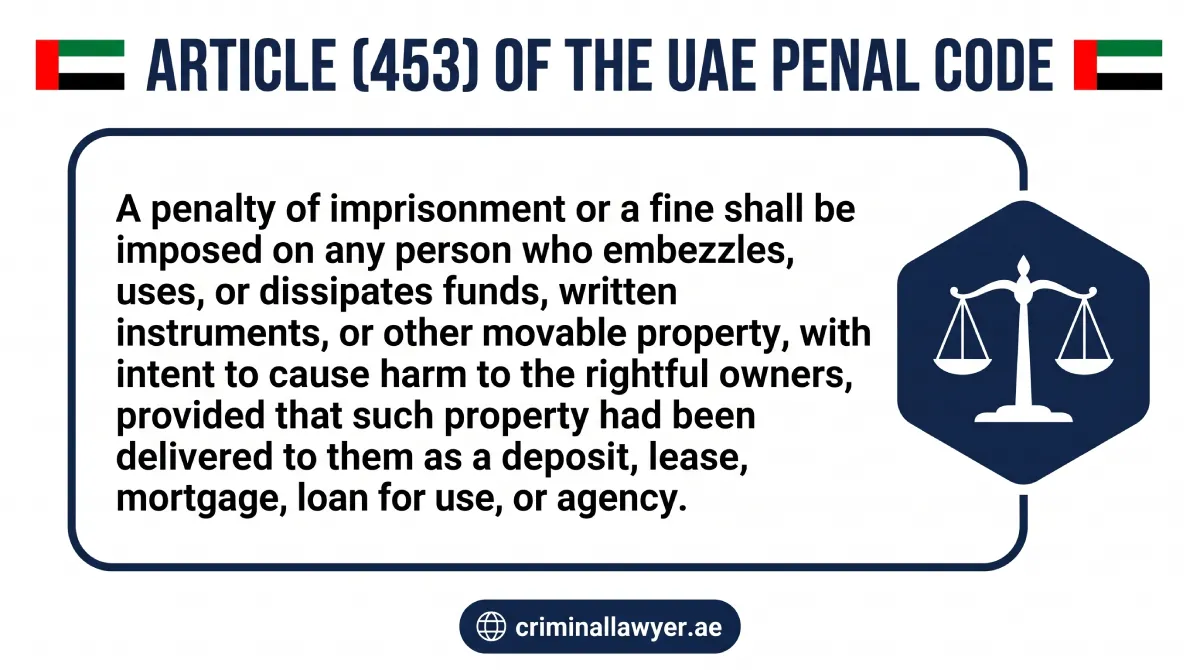
Article 453 of Federal Decree-Law No. 31 of 2021 governs breach of trust. It provides for imprisonment or a fine where a person misappropriates, uses or dissipates sums of money, documents of value or other movable property entrusted to them under one of the specified arrangements, thereby harming the persons entitled to that property.
The article identifies the following arrangements under which property may be entrusted:
- Deposit or safekeeping.
- Lease or hire.
- Pledge.
- Loan for use.
- Agency.
The article also treats a partner as an agent in relation to jointly owned property. It covers a person who intervenes in managing another person’s property, as well as someone who receives an item to use for a particular purpose for the benefit of its owner or another person.
What Acts Constitute Breach of Trust?
The law identifies three principal acts: misappropriation, unauthorised use and dissipation. A case may involve one of these acts or several overlapping forms of conduct.
1. Misappropriation of Property
Misappropriation occurs when someone treats property as their own even though the owner has neither transferred ownership nor granted unrestricted authority to dispose of it.
This may be shown by transferring entrusted funds to a personal account, selling an item, denying receipt of it, keeping the sale proceeds, or giving false information about what happened to it.
Not every refusal or failure to return property amounts to misappropriation. There may be factual or contractual reasons for a delay. The refusal must therefore be considered alongside other conduct indicating an intention to appropriate the property or cause harm.
2. Unauthorised Use of Property
Unauthorised use occurs when someone uses property for a purpose other than the one for which it was entrusted, even if they have not sold or damaged it.
For instance, a person may receive funds to pay particular fees but spend them on personal expenses. Alternatively, they may receive equipment for a specified project and transfer it to another project for their own benefit.
The scope of permission is crucial. If the agreement allowed unrestricted use of the funds, the offence may not be established. If their use was limited to a clearly defined task, acting outside that purpose may become a significant factor in the case.
3. Dissipation of Property
Dissipation occurs when someone deals with property in a way that causes it to be lost or makes its return impossible, such as selling, destroying or transferring it to another person without authority.
The act must be voluntary. The offence does not arise automatically if the property is lost in an incident that could not have been foreseen or prevented, unless deliberate conduct or another punishable act is established.
Elements of Breach of Trust under UAE Law
The offence requires interconnected elements. Proving only one element while leaving the others unestablished is not enough.
Lawful Delivery of the Property
The property must come into the recipient’s possession with the consent of its owner or an authorised representative. This distinguishes breach of trust from theft, where the offender takes property without the owner’s consent.
Delivery may be established through a contract, receipt, bank transfer, handover record or correspondence in which the recipient acknowledges receiving the property.
Delivery under a Recognised Relationship of Trust
The delivery must be connected with a deposit, lease, pledge, loan for use, agency or another arrangement treated as agency under Article 453.
A transfer between bank accounts is not enough on its own. The amount might be a loan, purchase price or contractual payment whose ownership passed to the recipient. In that case, the dispute may remain civil even if the other party fails to fulfil their obligation.
Misappropriation, Unauthorised Use or Dissipation
There must be an identifiable act contrary to the purpose for which the property was delivered. The act may be established through account transactions, a sale, a transfer, concealment, correspondence or the recipient’s admission of what they did.
Harm to the Rights Holder
The conduct must harm the person entitled to the property. Harm may consist of losing the property, being unable to recover it, being deprived of its use or suffering a reduction in its value.
The harm does not necessarily have to be permanent before proceedings can begin, but there must be an identifiable consequence directly connected with the conduct complained of.
Criminal Intent
The person must know that the property is subject to another person’s rights and deliberately act contrary to the purpose for which it was delivered.
هل أنت في هذا الموقف فعلاً؟
اشرح قضيتك لفريق خدمة العملاء، ويتم توجيهك إلى محامٍ جنائي مرخّص في الإمارات يناسب نوع قضيتك وإمارتك واللغة التي تفضّلها.
اشرح قضيتك الآن عبر واتسابأو تعرّف على كيفية سير الاستشارة · المحتوى مراجَع قانونيًا من الدكتور المحامي محمد الرملاوي — قيد رقم 120635
The court infers intent from the circumstances. It may consider transfers for personal benefit, denial of receipt, concealed accounts, contradictory explanations or selling property after its owner has demanded its return.
Negligence or poor management alone will not ordinarily establish criminal intent. There is therefore an important difference between a professional error and deliberate conduct indicating an intention to appropriate property or cause harm.
The presence of any one of these elements does not, by itself, establish the offence. They must be considered together in light of the facts of the case.
You may also be interested in: obtaining another person’s property through fraud in the UAE.
When Is a Dispute Breach of Trust and When Is It Civil?
Start by identifying the nature of the property. Then ask: Did ownership pass to the other party, or were they required to safeguard it, use it for a defined purpose and then return it or account for it?
A dispute is more likely to be civil when it concerns:
- A debt that was not paid on time.
- A disagreement over profits or accounts.
- A delay in performing a contract.
- A breach of a commercial obligation.
- Money paid as a purchase price or loan, where ownership passed to the recipient.
- An inability to pay without evidence of dissipation or an intention to appropriate the money.
Suspicion of a criminal offence becomes stronger when property was delivered for a restricted purpose, remained subject to the owner’s rights, and was then used for the recipient’s benefit, dissipated or denied by the recipient.
This distinction separates civil claims from breach of trust under UAE law. It also helps prevent criminal complaints from being used as pressure in purely contractual disputes.
A Quick Guide to Assessing the Nature of the Dispute
| Question | What Might It Indicate? |
|---|---|
| Did ownership of the property pass to the recipient? | The dispute may be civil. |
| Was a specific purpose set for using the property? | A relationship of trust may exist. |
| Was the property used for personal benefit? | This may strengthen suspicion of a criminal offence. |
| Are there outstanding mutual accounts that have not been settled? | The dispute requires civil and commercial examination. |
| Did the recipient deny having the property despite evidence? | This may be an indicator requiring further assessment. |
| Did the owner consent to the act? | The element of wrongful conduct may be absent. |
How Is Breach of Trust Proven in the UAE?
Breach of trust is a criminal offence under Federal Decree-Law No. 31 of 2021 on Crimes and Penalties in the UAE.
The offence is also subject to the UAE Criminal Procedure Law, issued under Federal Decree-Law No. 38 of 2022, which sets out the legal procedures for establishing criminal offences.
Proving breach of trust in the UAE involves several legal procedures, including:
- Investigation and questioning: conducting a thorough investigation and accurately recording the accused person’s statements.
- Collection of criminal evidence: such as documents, digital evidence and fingerprints that may support the allegation.
- Application of UAE rules of evidence governing the admissibility of evidence such as:
- Written evidence (contracts, instruments and receipts).
- Digital evidence (emails and electronic data).
- Witness testimony and circumstantial evidence.
- Inspections and expert examination, including collecting and comparing fingerprints.
The initial investigation report is an important document upon which accusations may be based. However, the court is required to question and examine the accused anew during trial hearings before issuing its judgment.
Can Breach of Trust Occur Between Business Partners?
The offence may occur between partners because Article 453 treats a partner as an agent in relation to jointly owned property.
This rule does not turn every disagreement between partners into a crime. Partners may disagree over profit distribution, the assessment of expenses or management powers. These matters remain civil or commercial unless it is established that a partner misappropriated, used or dissipated joint property with the intention of harming the other partners.
Review the memorandum of association, partnership agreement, minutes of decisions, account statements and signing authorities. Then identify the disputed sum or asset, how it left the company and who benefited from it.
Can Breach of Trust Occur in an Employment Relationship?
Breach of trust can occur at work, but an employment contract alone does not make property entrusted property for criminal law purposes.
The employee or manager must have received the property to safeguard, manage, deliver or use it for a specific task. It must then be established that they dealt with it for personal benefit or contrary to the purpose for which it was entrusted.
A stock shortage or discrepancy in accounts does not directly prove the offence. It could result from an accounting error, a weak system or several people having access to the assets.
Handover records, access logs, inventory reports, transfers, correspondence and audit reports can help determine responsibility more accurately.
Penalties for Breach of Trust under UAE Law
Federal Decree-Law No. 31 of 2021 on Crimes and Penalties in the UAE provides strict penalties for offences involving breach of trust, including the following:
- Penalty under Article 453: Imprisonment or a fine for anyone who misappropriates, uses or dissipates money, instruments or other movable property received as a deposit, under a lease, pledge, loan for use or agency arrangement, thereby harming the rights of those entitled to it.
- Penalty under Article 454: Imprisonment for up to two years or a fine of not less than AED 20,000 for anyone who takes possession, with intent to appropriate, of lost property belonging to another person or property that came into their possession by mistake or through force majeure, while being aware of those circumstances.
- Penalty under Article 455: The same penalties apply to a person who misappropriates or attempts to misappropriate movable property pledged as security for a debt they owe. The penalty also applies to an owner appointed as custodian of movable property seized by judicial or administrative order if they misappropriate any of it.
These provisions underline the seriousness of the penalties for breach of trust in the UAE, which are intended to protect financial rights and preserve trust between parties.
How Do I File a Breach of Trust Complaint in the UAE?
If the facts suggest that property was entrusted to someone who then dealt with it contrary to the agreed purpose, you should organise the documents and facts relating to its delivery and subsequent use. The procedure for filing a report and the necessary documents are explained in our guide on how to file a breach of trust complaint in the UAE.
The injured party does not initiate a criminal case in the same way as an ordinary civil claim. Proceedings generally begin with a complaint and investigation, after which the Public Prosecution may bring criminal proceedings if the requirements for bringing a breach of trust case are met.
When Do Breach of Trust Proceedings Expire under UAE Law?
The expiry of criminal proceedings and the lapse of a penalty are governed by rules and time limits separate from the elements of the offence and its original penalty.
Our article on the expiry of breach of trust cases explains the relevant periods and procedures. This article is limited to distinguishing the expiry of proceedings from the deadline for submitting a complaint.
When Should You Consult a Breach of Trust Lawyer in the UAE?
Seek a legal assessment when the situation involves a partnership or company, multiple accounts, disagreement over the purpose of transferring property, a high-value asset, or an investigation that has already started.
A lawyer handling breach of trust cases in the UAE can review the documents and assess whether the evidence supports a criminal complaint, a civil claim or a defence before the police, Public Prosecution or court.
Frequently Asked Questions About Breach of Trust under UAE Law
Here are some of the most common questions:
Does an unpaid debt by itself prove criminal misconduct?
No. Failure to repay a debt or meet a contractual obligation does not, by itself, establish breach of trust. The investigation must examine whether property was delivered under a legally recognised relationship of trust and whether the recipient deliberately misappropriated, used or dissipated it in a manner that harmed the rights holder.
Can bank records and messages help establish what happened?
Yes. Bank transfers, receipts, contracts and messages may help show why property was delivered, what limits were placed on its use, and what happened afterwards. Their significance depends on the full circumstances and other available evidence. A payment record alone does not necessarily prove criminal intent or establish the offence.
What if the property owner permitted the disputed transaction?
The owner's permission may be important because the scope of authority helps determine whether a transaction was unauthorised. The court may examine the agreement, correspondence and conduct of the parties to identify what was permitted. Consent to one transaction should not automatically be treated as permission for every subsequent use of the property.
Does a shortage in company accounts automatically implicate a partner?
No. A financial shortfall may arise from accounting errors, unsettled accounts or disputes over management authority. Criminal liability requires an assessment of the partner's powers and actions, including whether joint property was intentionally misappropriated, used or dissipated. Company records and the partnership agreement may be essential to that assessment.
To conclude our article on breach of trust under UAE law, we encourage anyone seeking to bring a related case to obtain legal assistance from the best criminal lawyer in the UAE at our firm.
Detailed methods of proving the offence, procedures for filing complaints, defences, the expiry of criminal proceedings and the lapse of penalties are separate topics, each covered in its own guide.
Are you facing a breach of trust charge? Contact the best criminal lawyer in the UAE now for confidential, specialist legal advice.
Learn more about: defences against a breach of trust charge in the UAE.

هل أنت في هذا الموقف فعلاً؟
اشرح قضيتك لفريق خدمة العملاء، ويتم توجيهك إلى محامٍ جنائي مرخّص في الإمارات يناسب نوع قضيتك وإمارتك واللغة التي تفضّلها.
اشرح قضيتك الآن عبر واتسابأو تعرّف على كيفية سير الاستشارة · المحتوى مراجَع قانونيًا من الدكتور المحامي محمد الرملاوي — قيد رقم 120635