

Legal review: Written and reviewed by a specialised legal team.
Last updated:2026/08/11.
Category: UAE Criminal Law.
A UAE resident had finished planning a trip abroad but wanted to check, before his flight, whether an old financial case had resulted in a travel ban in the UAE. He did not know whether his passport number would be enough to check, whether he needed his Emirates ID, or whether the procedure differed if the case was in Dubai, Abu Dhabi or Sharjah.
Situations like this arise in different forms. A financial claim or a pending case does not necessarily mean that a travel ban has been issued. The way to check also depends on the authority that imposed the restriction, the type of case and the emirate in which the file is held.
Have you discovered a travel ban that could affect your commitments or work in the UAE? Do not let uncertainty hold you back. Our lawyers specialise in reviewing legal restrictions, submitting applications to lift travel bans and resolving disputes as quickly as possible.
Or continue reading to learn about the reasons for travel bans and the lawful ways to check your status.
جدول المحتوبات
How Can I Find Out If I Have a Travel Ban in the UAE?
If you are asking, “How can I find out if I have a travel ban in the UAE?” or “How do I know if a judgment has been issued against me in absentia in the UAE?”, start by identifying the emirate where the case is held and the type of case that may be involved.
Based on the published government channels reviewed, there is no single federal online search that can be treated as a comprehensive check of every type of travel ban issued by all authorities across the country.
The UAE Government’s official portal explains that Dubai Police provides a free, round-the-clock online service for checking criminal status in financial cases in Dubai only, including whether those cases involve a travel ban. The portal also refers to Abu Dhabi’s “Estafser” service, which uses the Unified Number, and to the possibility of checking cases through the Federal Public Prosecution.
It is therefore best to follow a simple sequence: identify the emirate, establish the nature of the case where possible, and then use the appropriate official channel. If one service shows no restriction, that does not necessarily rule out an order issued by another authority outside that service’s coverage.
Checking a Travel Ban Using a Passport Number
Many people search for ways to check a travel ban using a passport number, especially those whose residency has expired or who are now outside the UAE. It is important to distinguish between using passport details to verify someone’s identity and having an official federal service that checks every travel ban simply by entering a passport number.
As of this article’s review date, the government channels referenced by the UAE Government portal do not offer a single service that checks all travel bans using a passport number alone.
The published service for financial cases in Dubai relies on Emirates ID details, while Abu Dhabi’s “Estafser” service requires the Unified Number.
If you do not have a valid Emirates ID, you should therefore avoid relying on unofficial websites that claim to provide a comprehensive travel ban check using only a passport number.
A more suitable approach is to identify the court or police authority likely to hold the case, use the identification details that authority requires, or ask a licensed lawyer to check the case through the lawful procedure.
Important: Holding a valid passport does not, by itself, mean that you are free of travel bans. Likewise, a result showing no restriction in a service with limited coverage is not necessarily confirmation that no other judicial authority has issued an order.
Pay close attention to what each search result actually covers. The UAE Government’s official portal describes the Dubai Police service as a criminal-status check for financial cases in Dubai only. Its result should not be treated as a nationwide check for every possible judicial or criminal order.
For Abu Dhabi, the government portal refers to the “Estafser” service, where users enter their Unified Number to make an enquiry within the service’s scope. It also points to enquiries through the Federal Public Prosecution.
The most useful outcome is therefore not simply learning whether a ban exists. Where possible, you should also obtain the case number, the authority that imposed the restriction and the reason for it, because those details determine the next step in applying to have the ban lifted.
Checking the case details becomes especially important if someone is outside the UAE and is concerned about an earlier judgment they did not follow up on. In that situation, our article on whether a judgment issued in absentia can be enforced outside the country in the UAE explains the implications of that judgment and the related procedures, which are separate from a travel ban enquiry.
How to Check Travel Bans Across Different Emirates
The channel used to check a travel ban in the UAE depends on where the case is held and which judicial authority has jurisdiction. A service limited to one emirate should not be presented as if it covers the entire country.
The following table offers a quick starting point, although you should check the circumstances of the actual case before taking any action.
| Emirate | Where to Start | Note |
|---|---|---|
| Dubai | The Dubai Police service referenced on the UAE Government portal | The published enquiry concerns financial cases in Dubai |
| Abu Dhabi | The “Estafser” service | Uses the Unified Number, according to the UAE Government portal |
| Sharjah | Federal judiciary and the relevant federal channels | Sharjah falls under the federal judicial system |
| Ajman, Fujairah and Umm Al Quwain | The competent federal judicial authorities, depending on the case | These emirates fall under the federal judicial system |
| Other cases | The authority that issued the order | The type of case determines the appropriate channel |
The UAE Government’s official portal explains that Sharjah, Ajman, Fujairah and Umm Al Quwain follow the federal judicial system, while other emirates have their own local judicial systems.
What Causes a Travel Ban in the UAE?
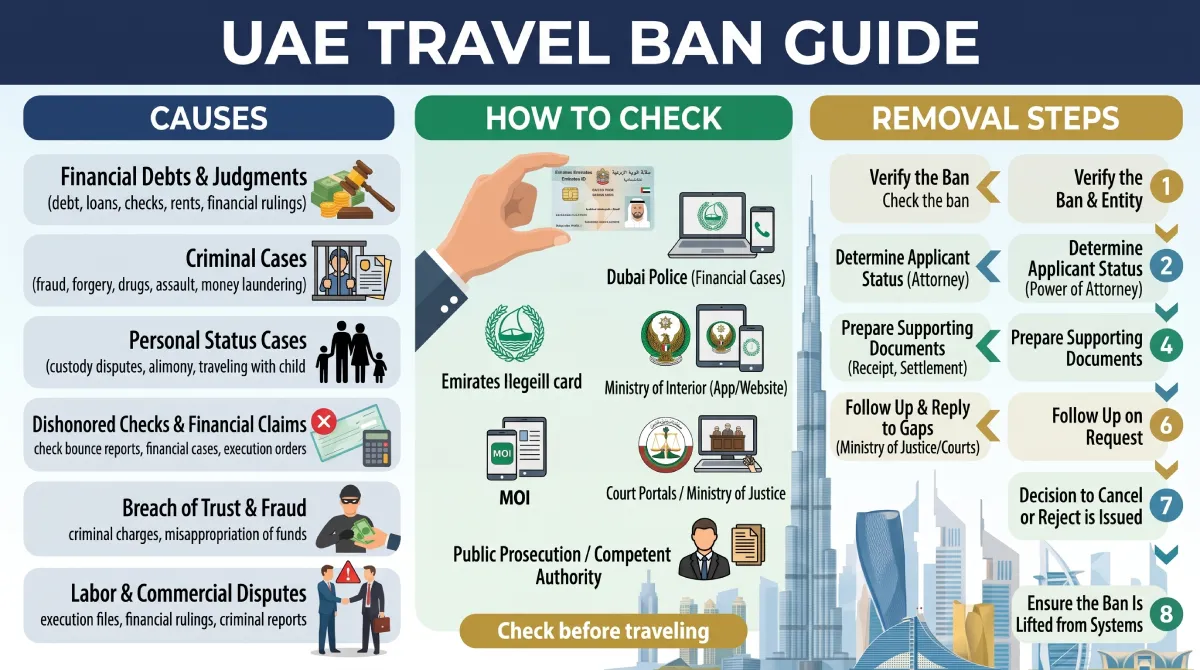
There are several possible reasons for a travel ban in the UAE, depending on the type of case and the authority issuing the order. A restriction may arise from a debt or enforcement case, a criminal matter, a family dispute or a precautionary application intended to protect someone’s legal rights.
A claim or complaint does not automatically result in a travel ban. The relevant legal and procedural conditions must be satisfied, and these differ according to the case. The main reasons include the following:
Travel Bans Arising from Debts or Enforcement Cases
A travel ban may be issued where a person owes an established sum of money or is subject to an enforcement claim, and the creditor fears that the debtor’s departure may obstruct recovery of the debt. This type of restriction often arises in enforcement proceedings involving loans, cheques, rent, monetary judgments or commercial claims. Whether it is ordered, however, depends on the application requirements and the competent authority’s assessment.
هل أنت في هذا الموقف فعلاً؟
اشرح قضيتك لفريق خدمة العملاء، ويتم توجيهك إلى محامٍ جنائي مرخّص في الإمارات يناسب نوع قضيتك وإمارتك واللغة التي تفضّلها.
اشرح قضيتك الآن عبر واتسابأو تعرّف على كيفية سير الاستشارة · المحتوى مراجَع قانونيًا من الدكتور المحامي محمد الرملاوي — قيد رقم 120635
Travel Bans in Criminal Cases
A travel ban may be imposed during the complaint, investigation or trial stage of a criminal case, particularly if the competent authority considers the person’s presence in the UAE necessary to complete proceedings or secure attendance.
This can arise in certain cases involving fraud, forgery, drug offences, assault, threats, cybercrime, money laundering or other criminal conduct.
Travel Bans in Personal Status Cases
Travel bans may also arise in family disputes, including disagreements over child custody, travelling with a child in custody, unpaid maintenance or the enforcement of family court judgments and orders. In these cases, the restriction is not a punishment but a measure intended to protect a legal interest or prevent harm to a party’s or child’s rights.
Travel Bans Involving Cheques and Financial Claims
Some cheque disputes can lead to financial, enforcement or criminal proceedings, depending on the facts and supporting documents. It would therefore be wrong to assume that every cheque automatically leads to a travel ban. The case status, any judgment or enforcement order, the amount claimed and the creditor’s actions must all be considered.
Travel Bans in Breach of Trust, Fraud and Other Criminal Disputes
Where a financial dispute involves a criminal allegation, such as breach of trust, fraud or misappropriation of funds, it may become a criminal matter that results in a travel ban if the competent authority finds the restriction necessary. It is therefore important to distinguish an exclusively civil dispute from one involving suspected criminal conduct.
Travel Bans in Certain Labour or Commercial Disputes
A labour or commercial dispute alone does not necessarily prevent someone from travelling. A restriction may arise, however, if the dispute develops into enforcement proceedings, a monetary judgment is issued, or a criminal complaint is involved, such as allegations of breach of trust, forgery or refusal to hand over money or documents.
How to Check a Travel Ban Using an Emirates ID
Several official and electronic channels may be used to check a travel ban in the UAE, but each may cover only a particular category of case or a specific emirate. It is therefore better not to rely on a single channel if you suspect that more than one case or complaint may exist. The options can be set out as follows:
- Checking through the Dubai Police service for financial casesDubai Police provides an online service for checking criminal status in financial cases within Dubai and whether a travel ban is connected to those cases. The enquiry generally uses an Emirates ID number and is particularly relevant for someone with a financial claim, cheque dispute or financial complaint in Dubai.
- Checking through the Ministry of Interior website or appThe Ministry of Interior’s official channels and related applications may provide enquiries about certain alerts or restrictions, depending on the case and the available information. This step may be helpful when a person does not know which authority issued the measure.
- Checking through court portals or the Ministry of JusticeIf the travel ban was issued by a federal court or is connected to enforcement proceedings, an enquiry or follow-up may be available through the Ministry of Justice website or the relevant court portal. A case number or enforcement file number is particularly useful for tracking the matter accurately.
- Checking through the Public Prosecution or the authority handling the criminal caseIn criminal cases, a travel ban may be linked to an investigation, complaint or order issued by a criminal authority. The person may therefore need to contact the Public Prosecution or use an available official enquiry channel according to the emirate and the type of case.
- Checking well before your travel dateDo not leave the enquiry until the day of your flight or a few hours before reaching the airport. Check early, particularly if you have an outstanding financial dispute, an earlier complaint, enforcement proceedings, a family case or any claim that has not been formally closed.
It is also important not to confuse enquiries about an existing case or travel ban with obtaining a police clearance or criminal record certificate. Each service has a different purpose and scope. If you need information on obtaining the certificate itself, read our guide to obtaining a criminal status certificate in the UAE. Such a certificate does not replace an enquiry to the competent authority about a travel ban.
Steps to Apply for the Removal of a Travel Ban in the UAE
Applying to lift a travel ban in the UAE involves several stages. Simply paying the amount owed or resolving the underlying reason does not necessarily mean that a person may travel immediately. The competent authority must issue an official decision or take the required action to remove the restriction. The steps are as follows:
- Confirm the travel ban and its reason: Start by establishing whether a travel ban actually exists and why it was imposed. Is it linked to enforcement proceedings, a financial claim, a criminal case, a court order or an ongoing complaint? You must also identify the issuing authority because the removal procedure differs depending on whether the order came from a federal court, local court, Public Prosecution or enforcement authority.
- Establish who is entitled to apply: An application to lift a travel ban cannot be filed by someone without the legal standing to do so. The applicant must be the person concerned or a lawful representative acting under valid authority. If a lawyer submits the application, evidence of the power of attorney or other legal authority must be attached.
- Address the underlying reason for the ban: Before applying, deal with the issue that led to the restriction. If it arose from a debt or enforcement proceedings, you may need to pay the amount, provide security, reach a settlement or submit evidence that the claim has ended. If the restriction is connected to a criminal case, the stage of the proceedings and whether the competent authority may lift it at that stage must be examined.
- Prepare the supporting documents: Attach documents showing that the reason for the travel ban no longer applies or that there is a legal basis to remove it. These may include a payment receipt, discharge letter, settlement agreement, creditor’s consent, court order, proof of bail or security, a copy of the Emirates ID or passport, the case or enforcement file number, and any other document required by the online system or relevant authority.
- Submit the application to lift the travel ban online: Once the documents are ready, apply through an approved electronic channel, such as the Ministry of Justice website or app for federal court cases, or the relevant court portal in the emirate where the ban was issued. The process commonly requires signing in through UAE PASS, completing the application details, uploading documents and paying any prescribed fees.
- Track the application and respond to requests for more information: After submission, the competent authority may accept the documents or ask for missing details or additional evidence. Continue checking the application’s status rather than assuming submission alone is sufficient, as incomplete documents can delay the decision.
- Receive the decision approving or rejecting the request: The relevant authority reviews the application and attachments and may decide to lift the ban, reject the request or require another step before deciding. If the request is refused, identify the reason so that any deficiency can be corrected, a new request submitted or another appropriate legal step taken.
- Confirm that the restriction has been removed from the systems before travelling: Even after an application is approved, check that the relevant systems have been updated and the travel ban has actually been removed before booking travel or going to the airport. A removal decision does not always mean that every system is updated immediately, so confirm the final status before making travel arrangements.
It is important to distinguish between submitting an application and the restriction actually being removed. Do not assume you can travel merely because you have filed a request. Follow up until the decision is issued and the competent authorities have updated the travel ban status before heading to the airport.
The Ministry of Justice lists a “Travel Ban Request” among its services, while an official page on proactive services also refers to a service for cancelling travel bans within the Public Prosecution’s services.
The procedure also varies according to who imposed the ban. Resolving a debt-related restriction is different from dealing with an order issued during criminal proceedings. The right starting point is therefore to obtain the case details and the decision, not simply to learn that someone is “banned from travelling”.
When Does a Travel Ban Expire in the UAE?
There is no single period after which every travel ban in the UAE automatically expires. The answer depends on the reason for the order, the type of case and the authority that issued it.
For a debtor’s travel ban, Article 325 of the Civil Procedure Law provides that the order remains in effect until the debtor’s obligation to the creditor who obtained it has been discharged, subject to specified circumstances in which the judge orders the ban to lapse.
The circumstances in which the law provides for a debtor’s travel ban to lapse include:
- One of the conditions required for issuing the ban no longer exists.
- The creditor gives written consent to lifting the order.
- The obligation secured by the travel ban has been discharged.
- Security acceptable under the law and to the judge is provided, depending on the case.
- An amount equal to the debt and expenses is deposited with the court treasury and allocated to settling the creditor’s claim.
- The creditor fails to provide evidence that a debt claim was filed within eight days of the order, in the circumstances governed by the provision.
- Other situations specified by Article 325 relating to enforcement of the judgment and whether the justification for the ban continues to exist.
Why Consult a Criminal and Enforcement Lawyer?
Travel ban cases in the UAE require careful handling because a restriction may stem from financial, criminal or family matters, or from enforcement proceedings. An error in filing a removal application or objection may result in refusal, delay the lifting of the ban or leave a person’s name flagged in the systems even though they believe the issue has been resolved.
A lawyer experienced in criminal and enforcement matters may assist in the following ways:
- Identifying the actual reason for the travel banA lawyer can help establish whether the restriction was imposed because of a debt, complaint, enforcement file, criminal case, judgment or application by another party. Identifying the reason is essential to selecting the right procedure.
- Reviewing the legal basis for the restrictionIt is not enough to know that a travel ban exists. The legal basis must be examined to determine whether the conditions were met, whether the reason still exists and whether the order can be challenged or lifted.
- Choosing the appropriate legal stepThe solution may involve paying a debt, providing security, entering into a settlement, filing an objection, requesting removal or following up on criminal proceedings. A lawyer can identify the appropriate route based on the type of restriction and the issuing authority.
- Preparing a legally supported application or objectionAn application that is poorly drafted or lacks evidence may be rejected or delayed. A lawyer can prepare the request and support it with documents showing that the reason for the ban no longer exists or that there are sound legal grounds for lifting it.
- Negotiating with the creditor or other partyIn some cases, a settlement, payment arrangement or discharge may lead to a travel ban being lifted or make approval of the request easier. Legal assistance can also help protect the client from agreeing to unbalanced terms.
- Following up on system updates after a removal orderSomeone may receive a decision lifting the ban but still need to confirm that the restriction has been deleted and the relevant systems updated before travelling. A lawyer can follow up to reduce the risk of an unexpected restriction at a border crossing or airport.
- Handling sensitive criminal mattersIf a travel ban is connected to a criminal case, investigation or complaint, a criminal lawyer may be needed. Removal may depend on the stage of the investigation, the accused person’s position, arrangements to secure attendance or the competent authority’s assessment.
If you are subject to a travel ban in the UAE or suspect that a restriction could prevent you from leaving the country, it is sensible to consult a lawyer before submitting an application. This allows the reason to be examined and the most appropriate legal procedure for your circumstances to be identified.
Frequently Asked Questions
Does an unpaid debt automatically stop someone from leaving the UAE?
An unpaid debt does not automatically mean a person is subject to a travel ban in the UAE. A restriction depends on the applicable legal conditions and a decision by the competent authority. If a financial claim or enforcement case is pending, check the relevant official channel before making travel plans.
Can a clear Dubai Police enquiry rule out restrictions elsewhere?
No. Dubai Police's published criminal-status enquiry concerns financial cases in Dubai and does not provide a comprehensive nationwide travel ban check. A restriction linked to a case in another emirate or issued by a different authority may not appear. Check with the authority handling the relevant case.
What if I no longer have a valid Emirates ID?
Not having a valid Emirates ID can limit access to services that require its details. It does not mean that a passport number alone will reveal every travel ban. Identify the authority likely to hold the case and use its accepted identification procedure, or seek assistance from a licensed lawyer.
Which details should I obtain if a restriction appears?
Try to identify the case or enforcement file number, the authority that issued the order, and the legal reason for the restriction. These details help determine where to direct a request and which documents may be needed. A simple yes-or-no search result may not provide enough information to act.
Dealing with a travel ban in the UAE requires three things: confirming whether a restriction exists, identifying the authority that imposed it and addressing the legal reason behind it. A result from one local service should not be treated as a comprehensive check of every possible restriction across the country.
Checking a travel ban using a passport number also does not mean there is a nationwide federal platform that works with a passport number alone. Identification requirements vary by authority, while cases in Abu Dhabi, Sharjah and other emirates must be checked through the relevant judicial channel.
Once a ban has been confirmed, it is not enough simply to resolve the underlying issue or submit a cancellation request. You should follow up until a decision is issued and confirm that the restriction has been removed before your travel date.
Also read: travel requirements after drug cases in the UAE.

هل أنت في هذا الموقف فعلاً؟
اشرح قضيتك لفريق خدمة العملاء، ويتم توجيهك إلى محامٍ جنائي مرخّص في الإمارات يناسب نوع قضيتك وإمارتك واللغة التي تفضّلها.
اشرح قضيتك الآن عبر واتسابأو تعرّف على كيفية سير الاستشارة · المحتوى مراجَع قانونيًا من الدكتور المحامي محمد الرملاوي — قيد رقم 120635