
In a case where the parties’ identities have been withheld to protect their privacy, an expatriate living in the UAE received a summons after a test indicated the presence of a controlled substance. His first question was: What constitutes a drug use offence in the UAE?
However, a review of the case file showed that a more important question comes before the penalty: Does the incident involve personal drug use, possession with intent to use, or evidence that could lead to a different legal classification?
This distinction matters because the law on combating narcotic drugs and psychotropic substances contains separate provisions for drug use, personal use and possession with intent to use. Drug trafficking and promotion, by contrast, are governed by other, more severe provisions.
The latest legislative amendment has also significantly changed the position of foreign nationals regarding deportation. Relying on articles or court rulings that predate the 2025 update could therefore lead to an inaccurate understanding of the current legal position.
Are you facing a drug use case and looking for reliable legal representation in the UAE? We make your search easier by recommending a qualified criminal defence lawyer with experience in drug cases, helping you protect your rights and pursue the best possible legal outcome.
Request a Specialist Lawyer Now
Or continue reading to learn more about the law.
جدول المحتوبات
What Is a Drug Use Offence in the UAE?
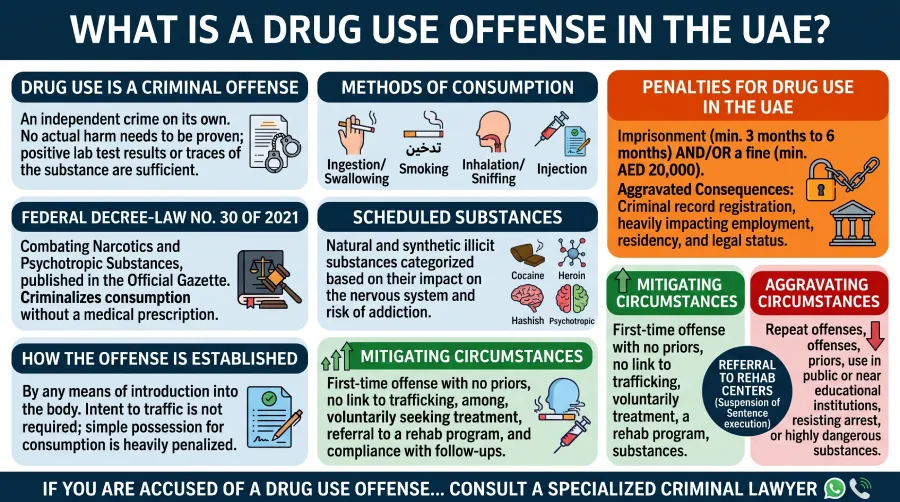
A Drug Use Offence in the UAE is legally distinct from drug trafficking or promotion. Its legal classification and penalty depend on the substance involved and the purpose for which it was possessed. Except where expressly permitted by law, UAE legislation criminalises the use of narcotic drugs and psychotropic substances for personal purposes. It also criminalises their possession or control when they are intended for personal consumption or use.
Drug use itself must also be distinguished from other, separate offences that may be associated with it, such as inciting another person to use drugs in the UAE, which has its own legal definition and rules.
The law was issued on 16 September 2021, published in Official Gazette No. 712 (Supplement) on 26 September 2021, and entered into force on 2 January 2022. The text referred to here is updated through 1 October 2025 and can be found in the official text published on the UAE Legislation Portal.
A positive drug test or the discovery of a substance in someone’s possession does not automatically settle the legal classification of the case. An assessment requires examining the substance involved, the legal schedule under which it falls, the laboratory report, the circumstances and procedures of the seizure, the purpose of possession, and whether the use was supported by a valid medical prescription or a treatment pathway recognised by law.
The circumstances become even more important when drug use is connected to conduct that may give rise to separate legal liability, such as drug use in connection with a road traffic accident in the UAE. Every incident must therefore be assessed according to its facts and the applicable legal provisions.
The Difference Between Possession for Personal Use and Possession with Intent to Traffic
When assessing a Drug Use Offence in the UAE, the key distinction is the intention behind possession and what the evidence establishes in each case. “Possession” and “trafficking” should not be used interchangeably. The following table sets out the general differences without going into trafficking penalties, so this article remains focused on drug use:
| Factor | Possession for Personal Use | Possession for Trafficking or Promotion |
|---|---|---|
| Purpose | Personal use | Sale, distribution or promotion |
| Scope of this article | A main subject of this guide | Covered in a separate article |
| Legal classification | Governed by the provisions on use and possession for personal use, depending on the substance and its schedule | Governed by the provisions on trafficking or promotion |
| Relevant evidence | Type of substance, laboratory report, circumstances of possession and the accused person’s statements | Indicators of an intention to sell or distribute, alongside other evidence |
| Severity of penalty | Determined under the applicable drug use provisions | Generally more severe than the penalty for personal use |
The Federal Supreme Court has also highlighted the practical importance of distinguishing possession of a psychotropic substance with intent to traffic from drug use, confirming that each has its own legal basis and penalty.
For more information about the separate offence, read our article on drug trafficking in the UAE, rather than expanding on trafficking penalties here.
Schedule of Controlled Drugs in the UAE
The UAE federal law on narcotic drugs distinguishes between natural and synthetic substances through the schedules attached to it. These schedules form an integral part of the legislation.
Controlled substances include, but are not limited to:
- Hashish
- Cocaine
- Heroin
- Methamphetamine
- Tramadol (when used without a lawful prescription)
- Psychotropic substances
Classification depends on the substance’s effects on the nervous system and its potential to cause psychological or physical dependence. A substance may therefore fall within the scope of UAE drug offences even when the quantity involved is small.
Penalty for Drug Use in the UAE for Expatriates
For expatriates facing a Drug Use Offence in the UAE, two issues must be examined separately: the penalty for drug use and the possibility of deportation.
Under Article 41(1), the penalty is imprisonment for at least three months or a fine of AED 20,000 to AED 100,000. The outcome varies according to the substance, the relevant schedule, previous offences and the final legal classification of the incident. This corrects a point in the previous version of the article, which broadly described the penalty as three to six months’ imprisonment together with a fine.
(Article 41, Federal Decree-Law No. 30 of 2021; Official Gazette No. 712, Supplement; issued on 16 September 2021; effective from 2 January 2022; based on the latest published update dated 1 October 2025.)
Repeat offending also has important legal consequences. A subsequent case cannot automatically be treated as a “third offence”, nor can repeat-offender provisions be applied without examining when the earlier offence occurred and which law governed it. In Criminal Appeal No. 1539 of 2024, decided on 24 July 2025, the Federal Supreme Court overturned a judgment because the order of the drug use offences had been calculated incorrectly under the transitional rules of the amendment.
When Does Drug Possession Become a Felony Involving Trafficking?
Where possession is found to involve narcotic drugs or psychotropic substances listed in the schedules, or is accompanied by indications of an intention to promote or traffic them—such as weighing and packaging equipment or substances divided into separate quantities—the offence may be classified as a felony. The penalties are more severe and may extend to life imprisonment or the death penalty under Articles 47 and 48 of the same law.
The following table compares possession for personal use with possession for trafficking under UAE law:
| Factor | Personal Drug Use | Trafficking or Promotion |
|---|---|---|
| Legal classification | Misdemeanour | Felony |
| Basis | Personal use | Intention to sell or distribute |
| Penalty | Short-term imprisonment or a fine | Long-term or life imprisonment |
| Legal consequences | Criminal record | A serious offence that may affect public security |
If your case concerns possession of drugs for personal use and you are concerned that the charge could be escalated to trafficking, early legal intervention may influence the course and outcome of the investigation. You can use the WhatsApp button at the bottom of the page to request an immediate legal consultation.
هل أنت في هذا الموقف فعلاً؟
اشرح قضيتك لفريق خدمة العملاء، ويتم توجيهك إلى محامٍ جنائي مرخّص في الإمارات يناسب نوع قضيتك وإمارتك واللغة التي تفضّلها.
اشرح قضيتك الآن عبر واتسابأو تعرّف على كيفية سير الاستشارة · المحتوى مراجَع قانونيًا من الدكتور المحامي محمد الرملاوي — قيد رقم 120635
Is Deportation Mandatory, or Can an Exemption Be Requested?
This particular issue has changed and is a key reason the article needs updating. Under the amended wording of Article 75, the court orders the deportation of a foreign national convicted of an offence under the drug control law, subject to specified exceptions.
The first exception applies when, at the time of the offence, the convicted person was married to a UAE national or was a first-degree blood relative of a UAE national. The provision also addresses another situation involving a member of a family residing in the UAE, where the court considers that deportation would seriously harm family stability or deprive a family member of care, subject to the requirements set out in Article 75.
The question “Can I seek an exemption from deportation?” therefore has no unconditional yes-or-no answer. The first step is to determine whether a statutory exception applies and support it with documents before the competent authority. The available procedural options can then be assessed according to the stage of the case and the type of judgment issued.
Further details are available in our article on deportation from the UAE in drug cases. That article should also be updated to reflect the new wording of Article 75 before it is relied upon.
Mitigating Factors in UAE Drug Use Cases
The law does not contain a provision literally stating that “five mitigating circumstances” automatically apply to every case. It is more accurate to identify five factors and legal pathways that may reduce the penalty, prevent criminal proceedings from being initiated, or limit a consequence of the judgment, depending on the circumstances.
The following five factors are worth examining when assessing a Drug Use Offence in the UAE:
- Seeking treatment before apprehension or the issue of an arrest warrant. Article 89 regulates cases in which criminal proceedings are not brought against a person who uses drugs if the treatment process is initiated before apprehension or before an arrest warrant is issued, by the persons and through the procedures and conditions specified by law. This is more than an act of leniency: where all statutory conditions are met, it may prevent proceedings from being brought in the first place. (Article 89, Federal Decree-Law No. 30 of 2021, as amended; Official Gazette No. 712, Supplement; text updated through 1 October 2025.)
- Proof that the substance was used for treatment under a valid medical prescription. The Federal Supreme Court has confirmed that use for medical treatment may be exempt from punishment when it is based on a prescription that meets the legal requirements and was issued by a licensed physician. In Criminal Appeal No. 1392 of 2024, heard on 22 April 2025, the Court held that a defence based on an approved medical prescription was a material defence that had to be examined.
- Where the offence is the first or second instance and the relevant provision applies. Article 67 excludes first- and second-time drug use and personal use offences from the general restriction on reducing penalties for certain drug offences. This leaves scope for mitigation in qualifying cases. The Federal Supreme Court confirmed this principle in Criminal Appeals Nos. 947 and 1018 of 2024.
- Ensuring that previous offences are counted correctly. A previous conviction does not automatically mean that the current case must be treated as a second or third offence. The date of the earlier incident and the commencement dates of the relevant amendments must be checked. In Criminal Appeal No. 1539 of 2024, the Federal Supreme Court confirmed that incorrectly counting a previous offence leads to an error in the application of the penalty.
- For expatriates, the availability of a statutory exception to deportation. This factor does not, by itself, reduce a prison sentence or a fine, but it may have a major effect on the practical outcome. The amended Article 75 regulates exceptions relating to connections with a UAE national or a family residing in the country, and to the serious harm that deportation could cause, subject to the legal conditions.
The penalty for drug use in the UAE for expatriates therefore cannot be predicted from a single factor, such as having no previous convictions. The outcome depends on the applicable law, the evidence, the type of substance, the dates of the incidents, any treatment pathway and the accused person’s individual circumstances.
Is Drug Use a Misdemeanour or a Felony?
The basic form of a drug use offence, punishable by imprisonment or a fine, differs from the more serious felonies involving trafficking and promotion. The UAE Crimes and Penalties Law classifies offences by the penalties prescribed for them, while the drug control law sets out separate penalties for each prohibited act.
A relatively large quantity of drugs should therefore not, on its own, be treated as automatically turning a personal use case into a trafficking felony. The legal classification depends on evidence of intent and the surrounding facts. This distinction is also essential to keeping the subject of this article separate from that of the trafficking article.
It is important to note that the final legal classification rests with the Public Prosecution and the court, based on physical evidence and expert reports. Seeking assistance from a lawyer specialising in drug cases is therefore particularly important at this stage.
Legal Procedures in Drug Use Cases
An effective defence against a Drug Use Offence in the UAE begins at the evidence-gathering stage, not after a judgment has been issued. A drug use case typically involves arrest or seizure, investigation, a laboratory report and, if referred to court, a trial.
The process generally follows these stages:
- Arrest, seizure and evidence gathering: Preparing official reports, securing any seized substance and collecting samples according to the prescribed procedures.
- Laboratory testing: Identifying the substance found in the sample or seized items, including its scientific name.
- Public Prosecution investigation: Examining the accused person’s statements and the evidence to determine whether the conduct amounts to drug use, possession for personal use or another offence.
- Referral to court: This occurs if the Public Prosecution considers there is sufficient evidence to bring a case.
- Judgment and related consequences: These may include criminal penalties and, for foreign nationals, deportation under the applicable law.
From a legal practice perspective, the lawfulness of arrest and search procedures, the laboratory report, medical prescriptions, the dates of previous offences and the accused person’s statements are among the most important matters to review before deciding on a defence strategy.
How Long Does a Drug Use Case Take?
A drug use case in the UAE typically takes one to three months in straightforward cases. It may take longer if there are aggravating circumstances or the charge is reclassified.
Several factors affect the duration of a case, including:
- The time needed to complete laboratory drug testing.
- Whether the accused is being held in custody during the investigation.
- Any previous criminal convictions.
- The number of court hearings.
- The complexity of the evidence or the involvement of multiple defendants.
When Can a Drug Use Conviction Be Set Aside Under the New Law?
Although UAE drug laws take a firm approach to combating narcotics, the new UAE drug law also recognises the human and social dimensions of addiction. It creates a legal pathway for people who use drugs—particularly first-time offenders—to receive treatment instead of punishment, subject to strict requirements and conditions.
Article 89 of Federal Decree-Law No. 30 of 2021 provides that a relative of a person who uses drugs, or someone living with that person, may apply to the competent authorities for addiction treatment before the offence is detected. In such cases, no criminal proceedings are taken against the person, provided that the treatment and monitoring programme is fully followed.
Conditions for Exemption from Punishment for Drug Use in the UAE
- The application must be submitted before the person is apprehended by the police.
- The person must not have committed another drug-related offence, such as promotion or smuggling.
- The person must show a genuine willingness to undergo treatment and submit to medical supervision.
- The person must complete the prescribed treatment period and comply with the centre’s instructions.
Who Can Submit a Treatment Request?
- The father, mother or another relative up to the second degree.
- The husband or wife.
- Anyone who normally lives with the person who uses drugs and is concerned about their health or behaviour.
When Is the Exemption from Drug Penalties Revoked and the Investigation Resumed?
- If the person refuses to follow the treatment programme or stops attending follow-up appointments.
- If the person commits another offence during treatment.
- If the person is found to have provided false information when submitting the application.
This legal pathway encourages addiction to be addressed as a treatable health and social problem rather than solely as an offence requiring punishment. It reflects the UAE legislature’s effort to balance deterrence with compassion.
Medical Testing for Drug Use Offences in the UAE
A person accused or convicted of a Drug Use Offence in the UAE may be required to undergo periodic medical testing under the applicable law. Refusing to provide a sample without a valid reason is a separate offence punishable by law.
Article 1 of Federal Decree-Law No. 30 of 2021 on Combating Narcotic Drugs and Psychotropic Substances defines the concept of “compulsory submission” as requiring a person to follow drug-testing procedures under rules established by the competent authorities.
Article 79 of the same law also provides that:
- A person convicted of a drug use offence,
- Or a person admitted to a facility under a court order,
- Or a person who refuses to provide a test sample without a lawful excuse,
is subject to periodic testing for a period not exceeding two years after the sentence has been served or the placement period has ended.
Frequently Asked Questions About Drug Use Offences in the UAE
Can a positive drug test alone establish a drug use offence?
No. A laboratory result is an important piece of evidence, but the legal assessment also depends on the identified substance, the relevant statutory schedule, the collection and testing procedures, and any lawful medical explanation. The Public Prosecution and the court assess the evidence together before determining the appropriate charge.
Can a valid prescription affect how a drug use case is decided?
Yes. A prescription may be relevant where a controlled substance was used for genuine medical treatment. Its validity, the prescribing doctor's licence and compliance with applicable requirements must be examined. The Federal Supreme Court has treated a properly supported prescription defence as a material issue requiring judicial consideration.
Is imprisonment unavoidable for someone with no previous convictions?
Not necessarily. The applicable penalty depends on the substance, the statutory provision and the circumstances of the offence. Under Article 41(1), certain cases may attract imprisonment or a fine. A lack of previous convictions can matter, but it does not automatically guarantee a fine, treatment or exemption from prosecution.
What evidence might distinguish personal possession from distribution?
Investigators assess the purpose of possession rather than relying on quantity alone. Relevant evidence may include the type and amount of substance, packaging, weighing equipment, communications, laboratory findings and the accused person's statements. No single indicator automatically establishes trafficking; the legal classification must follow the evidence considered as a whole.
This guide has explained the key legal provisions governing a Drug Use Offence in the UAE, including the applicable penalties, the distinction between personal use and possession, the potential consequences for expatriates, and the circumstances in which treatment or a statutory exemption may be available under the law.
Because drug cases require prompt and carefully considered action, seeking legal advice early can help you understand your legal position and avoid mistakes during an investigation or when giving statements.
You may also be interested in: appealing a drug case judgment in the UAE: a comprehensive guide.

هل أنت في هذا الموقف فعلاً؟
اشرح قضيتك لفريق خدمة العملاء، ويتم توجيهك إلى محامٍ جنائي مرخّص في الإمارات يناسب نوع قضيتك وإمارتك واللغة التي تفضّلها.
اشرح قضيتك الآن عبر واتسابأو تعرّف على كيفية سير الاستشارة · المحتوى مراجَع قانونيًا من الدكتور المحامي محمد الرملاوي — قيد رقم 120635